
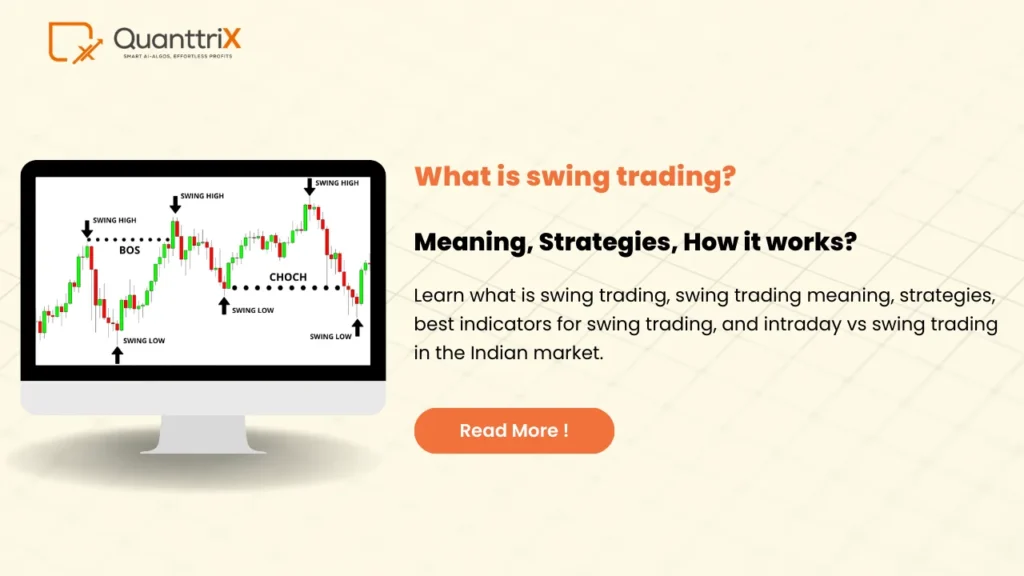
What is swing trading? Meaning, Strategies, How it works?
Swing trading exemplifies a favoured manner of trading in a stock market which emphasizes the short-to medium-term price fluctuations in stocks, indexes, or other financial products. Through this guide, you will get to know what swing trading is, how swing trading occurs, the most suitable swing trading strategies, and the most supportive indicators to swing trading.
Swing trading is generally considered to have a period of few days to just weeks; hence it is appropriate to traders who prefer to take advantage of market trends without necessarily watching the screen all the time.
The difference between intraday trading and swing trading expressed clearly in this paper also allows a beginner to decide on the type of trading that fits best based on their time, risk tolerance, and objectives.
What Is Swing Trading?
Swing trading is the process of buying and holding stocks over a short period of a few days up to weeks in order to get the short-term trends. It presents an interplay between day to day trade and long term investment.
Swing trading can work in Indian markets, with the appropriate risk management combined with the appropriate indicators.
Swing Trading Meaning
Swing trading is a short to medium term trading approach in which traders seek to trade price up and down movements that take place within days or weeks.
The positions are not closed on the same day as in intraday trading. Rather, traders leave trends to form and trade risk through stop-loss levels.
In simple words:
- Intraday trading = day in day out entry and exit.
- Swing trading = Multipurpose trades.
- Investing = Long-term holding
Why Is Swing Trading Popular in the Indian Market?
Swing trading has gained popularity in India because:
- It requires less screen time
- It suits working professionals
- It works well in trending stocks
- It avoids excessive brokerage costs
As an illustration, in case a NIFTY 50 stock clears above a major resistance with a substantial volume, a swing trader can hold it between 7-15 days with a target of 5-10 percent.
Swing Trading Strategies Popularly Used in India
- Intrinsic Strategy: Sell when price breaks the resistance and high turnover.
- Pullback Strategy: Buy when the price has revived back to support an existing uptrend.
- Moving Average Strategy: Two 20-day and 50-day moving averages are used to determine the direction of the trend.
- RSI Reversal Strategy: Reversal signs are evident when RSI hits the oversold zone.
- Trendline Strategy: Enter near trendline support and exit when structure breaks.
Best Indicators for Swing Trading
The best indicators for swing trading are those that combine trend and momentum.
- Moving Averages (20, 50, 200 DMA)
- RSI (Relative Strength Index)
- MACD
- Volume analysis
- Bollinger Bands
Indian traders often combine price action with RSI and volume confirmation for better probability setups.
Advantages and Disadvantages of Swing Trading
Below is a structured comparison table for better clarity.
Swing Trading: Advantages vs Disadvantages
Advantages of Swing Trading | Disadvantages of Swing Trading |
Requires less screen time compared to intraday trading | Exposure to overnight gap risk |
Lower brokerage and transaction costs | Capital remains locked for multiple days |
Allows better risk-reward setups (1:2 or 1:3) | Slower returns compared to scalping |
Suitable for working professionals | Emotional stress during overnight volatility |
Works well in trending markets | Not ideal during highly sideways markets |
Easier to manage with daily chart analysis | Requires patience and discipline |
This table helps traders realistically evaluate whether swing trading fits their personality and schedule.
Intraday vs Swing Trading
One of the most searched topics is intraday vs swing trading. Here is a clear comparison.
Swing Trading vs Intraday Trading
Parameter | Intraday Trading | Swing Trading |
Holding Period | Minutes to hours | Days to weeks |
Time Commitment | Full-day monitoring required | 1–2 hours daily analysis |
Overnight Risk | No | Yes |
Stress Level | High due to fast volatility | Moderate |
Leverage Usage | Commonly used | Optional |
Capital Requirement | Lower due to margin facility | Moderate |
Suitable For | Full-time traders | Working professionals & part-time traders |
Brokerage Costs | Higher due to frequent trades | Lower due to fewer trades |
Risk Exposure | Limited to trading day | Affected by global overnight news |
Emotional Pressure | Very high | Manageable with discipline |
Risk Management in Swing Trading
Regardless of strategy, risk management is critical.
Follow these principles:
- Risk only 1–2% of total capital per trade
- Always use stop-loss
- Avoid overtrading
- Do not average losing trades blindly
Example:
If your capital is ₹10,00,000, your maximum risk per trade should ideally not exceed ₹10,000–₹20,000. Swing trading is about consistent gains, not aggressive speculation.
When Should You Choose Swing Trading?
Swing trading may be suitable if:
- You cannot watch markets continuously
- You prefer structured analysis after market hours
- You want balanced risk exposure
- You are transitioning from investing to active trading
If you are a full-time trader comfortable with fast execution, intraday trading may suit you better.
Common Mistakes in Swing Trading
- Entering late after extended rally
- Ignoring broader market trend
- Holding losers without stop-loss
- Trading low-liquidity stocks
- Overexposing capital in one position
Avoiding these mistakes improves long-term consistency.
Conclusion
Swing trading has emerged as one of the most viable models to be used by retail traders in India. It provides a middle way between intraday trading at high intensity and long-term investing. The probability based decision making can be enhanced by knowing what is swing trading, working out organized swing trading plans, and employing the most suitable swing trading indicators.
Intraday or swing trading is a decision that is finally based on the personality, availability of time and risk tolerance. Through good discipline, risk management, and organization of education; swing trading may become an established and viable trading strategy in the Indian markets.
At the Trendy Traders Academy we target to teach the traders the proper way of trading and not just trading by following a trend. The race to be a good trader is not a race, it is a race to be well organized and to take control of risks.
FAQ'S
What is swing trading?
Swing trading is a trading method in which the trader keeps the positions over a few days to a few weeks in order to acquire price changes in the short run.
What is the swing trading meaning?
It implies trading price changes that take more than one day to happen rather than the same day trading.
What are the most appropriate swing trading indicators?
The indicators commonly used are moving averages, RSI, MACD, volume analysis and Bollinger Bands.
Which is the safest way of trading: intraday or swing?
Swing trading requires less daily tension yet has the risk of being overnight. Intraday trading is not subject to the over-night risk but more subject to day volatility.
Is it possible to begin swing trading?
No, swing trading can be a good beginning since it can be analyzed and a decision made.

