
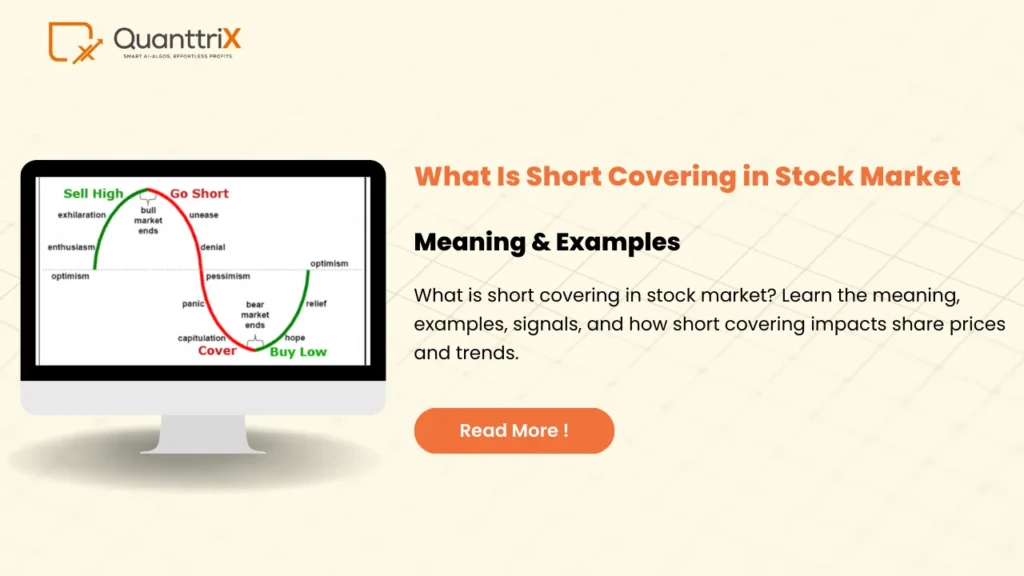
What Is Short Covering in Stock Market? Meaning & Examples
If you have ever noticed a stock falling for days and then suddenly rising sharply without any major positive news, chances are short covering was at work. Short covering is one of those market concepts that sounds technical at first but becomes very logical once you understand how traders actually behave.
In simple terms, short covering happens when traders who had earlier bet on a stock falling decide to exit their positions by buying the same stock. This buying activity itself creates demand, which can push prices higher, sometimes very quickly. Many sharp intraday rallies and sudden reversals after prolonged declines are driven by short covering rather than fresh long-term buying.
For traders and investors, understanding short covering is important because it explains why prices sometimes rise even when fundamentals or news do not seem supportive. This guide explains What Is Short Covering in Stock Market, short covering in share market, how to identify short covering stocks, and how traders use this concept in real market situations.
What Is Short Covering in Stock Market?
Short covering means to the process of buying back shares that were earlier sold short. When traders expect a stock to fall, they sell it first with the intention of buying it back later at a lower price. This strategy is called short selling.
However, short positions cannot remain open forever. At some point, traders must buy back the shares to close their positions. When this buying happens, it is called short covering.
In simple words, short covering means exiting a short trade by purchasing the stock.
Short Covering Means in the Share Market
To understand short covering in share market clearly, it helps to look at how a short trade works step by step.
A trader believes a stock priced at ₹500 will fall
- The trader sells the stock at ₹500 without owning it
- The stock falls to ₹450
- The trader buys it back at ₹450
- The profit is ₹50 per share
The final step, where the trader buys back the stock, is short covering. Even though the trader is “buying,” it does not mean they are bullish. They are simply closing their earlier bearish position.
When many traders do this at the same time, buying pressure increases and prices move up.
Why Does Short Covering Happen?
Short covering usually happens for one of the following reasons.
- The stock has fallen enough, and traders decide to book profits
- The price starts moving up, and traders want to limit losses
- A key event or announcement creates uncertainty
- Expiry of futures and options contracts
- Risk management rules force traders to exit positions
In all these situations, the common action is buying back shares, which creates upward pressure on price.
How Short Covering Impacts Stock Prices?
Short covering can lead to fast and sometimes aggressive price movements. Since short sellers are already under pressure when prices rise, they tend to buy quickly rather than wait for better prices.
This urgency creates a chain reaction.
- Price moves up slightly
- Some short sellers start covering
- Their buying pushes price higher
- More short sellers panic and cover
- Price accelerates upward
This is why short covering rallies often look sharp and emotional on charts.
Short Covering vs Fresh Buying
It is important not to confuse short covering with fresh buying. Short covering is defensive buying. Traders are closing existing positions. Fresh buying is aggressive buying. Traders are creating new long positions.
A rally driven by short covering may not sustain for long if fresh buyers do not enter. Once most short positions are closed, the buying pressure fades, and prices may consolidate or reverse.
This distinction is crucial for traders who chase sharp moves without understanding what is driving them.
Short Covering in Intraday Trading
Short covering is very common in intraday trading. Many intraday traders sell stocks early in the session when they expect weakness. If the market does not fall as expected or starts recovering, these traders rush to cover positions before the close.
This is why markets often show sudden up-moves in the last hour of trading. Intraday shorts prefer not to carry positions overnight, leading to short covering before the market closes.
Short Covering Stocks: How to Identify Them
Identifying short covering stocks requires observation rather than prediction. Some common signs include:
- A stock falling for several sessions and then showing a strong green candle
- Price rising with moderate volume, not extreme delivery buying
- Open interest declining while price rises in derivatives
- Sharp intraday reversals after early weakness
- Recovery without major positive news
In derivatives data, falling open interest combined with rising price is a classic sign of short covering.
Short Covering in Futures and Options
Short covering in share market is closely tracked in the futures and options market. Since every futures position has open interest data, traders can see whether positions are being created or closed.
When price rises and open interest falls, it usually indicates short covering. When price rises and open interest rises, it indicates long buildup. Understanding this difference helps traders avoid misinterpreting market moves.
Short Covering vs Short Squeeze
Short covering and short squeeze are related but not the same.
Short covering is normal position exit. Short squeeze is forced short covering due to extreme price movement.
In a short squeeze, prices rise so fast that short sellers are forced to cover at much higher prices, often leading to explosive rallies. Short squeezes usually happen in stocks with low liquidity and high short interest.
Role of News and Events in Short Covering
What Is Short Covering in Stock Market? Short covering can happen even without news, but certain events increase its probability.
- Earnings results better than feared
- Policy announcements reducing uncertainty
- Global market recovery after panic selling
- Index rebalancing or expiry-related adjustments
In such situations, traders who were bearish quickly reassess risk and cover positions.
Can Investors Benefit From Short Covering?
Short covering mainly benefits short-term traders. Long-term investors should be cautious about buying purely because a stock is rising due to short covering.
Since short covering does not reflect genuine demand, prices may not sustain. Investors should look for confirmation through fundamentals, volume expansion, and follow-through buying.
Common Mistakes Traders Make With Short Covering
Many traders chase stocks during short covering rallies, assuming a trend reversal. Others misread every bounce as short covering without checking open interest or volume.
Another common mistake is assuming that short covering guarantees upside. In reality, it often leads to temporary relief rallies rather than long-term uptrends.
Practical Example of Short Covering
Imagine a stock that has fallen from ₹300 to ₹220 over two weeks. Many traders are short. One morning, the stock opens flat instead of gap-down. As the day progresses, it starts moving up slowly.
Short sellers become uncomfortable. Some begin to buy back shares at ₹230, then ₹235. As more shorts cover, the price moves to ₹245 by the end of the day.
There is no major news. The move is driven largely by short covering. The next few sessions will decide whether fresh buyers step in or the rally fades.
Short Covering and Market Psychology
Short covering reflects fear and risk management rather than optimism. Traders cover not because they love the stock, but because they want to protect capital.
This emotional aspect explains why short covering rallies are often fast, uneven, and short-lived. Understanding this psychology helps traders avoid emotional decisions.
Conclusion
Short covering in share market is an essential concept for anyone trying to understand real market behaviour. It explains why prices sometimes rise sharply even when news and fundamentals remain unchanged. At its core, short covering is about traders exiting bearish positions, not about new confidence in a stock.
For traders, identifying short covering helps avoid chasing false breakouts and improves timing for exits or quick trades. For investors, it acts as a reminder to differentiate between temporary price recovery and genuine trend reversal.
Markets move not just because of information, but because of positioning. Short covering is a clear example of how trader behaviour can temporarily overpower fundamentals.
FAQ'S
What is short covering in stock market?
Short covering is the act of buying back shares that were earlier sold short to close a position.
Does short covering mean bullishness?
No, it usually reflects traders exiting bearish positions, not fresh bullish buying.
How can I identify short covering stocks?
Rising price with falling open interest and moderate volume often indicates short covering.
Is short covering good for long-term investors?
Not necessarily, as short covering rallies may not sustain without fresh buying.
What is the difference between short covering and short squeeze?
Short covering is normal exit, while a short squeeze is forced exit due to rapid price rise.

