
What is Sharpe Ratio in Mutual Funds? Meaning & Formula
A majority of investors tend to evaluate a mutual fund in one single number, which is returns. Though returns are significant they seldom convey the entire story. A fund that provides high returns in a given year can also subject a fund investor to sharp fall and rise, restless nights and panic selling in case of a correction.
This is where the Sharpe Ratio comes in extremely handy. Rather than look just at the amount that a fund made, it provides an answer to a more practical question: Was the return worth the risk taken? The Sharpe Ratio assists the investor in distinguishing between quality returns and the lucky returns.
It promotes a more relaxed, disciplined attitude towards investment- particularly in volatile markets such as India- of long term mutual fund investors. In this guide we’ll explain about what is sharpe ratio in mutual funds, best sharpe ratio mutual funds in India, sharpe ratio in mutual fund formula, sharpe ratio meaning in mutual fund, sharpe ratio in mutual fund.
What is Sharpe Ratio in Mutual Funds?
The Sharpe Ratio is a metric that measures risk-adjusted returns.
In simple words, it tells you:
How much extra return a mutual fund has generated for every unit of risk it has taken. Risk here refers to volatility-how much the fund’s returns fluctuate over time.
When two funds are producing similar returns, the one with a lower volatility (and, therefore, a higher Sharpe Ratio) is deemed to be better in a risk-adjusted view. William F. Sharpe had coined the concept and it became one of the most frequently used methods of portfolio analysis in the world.
Sharpe Ratio Meaning in Mutual Fund
Let’s break the Sharpe Ratio Meaning in Mutual Fund down.
- Return tells you how much you made
- Risk tells you how bumpy the journey was
- Sharpe Ratio tells you whether the journey was worth it
A mutual fund with a high Sharpe Ratio means:
- Returns were relatively consistent
- Volatility was controlled
- Investors were rewarded adequately for the risk taken
A low Sharpe Ratio means:
- Returns were achieved with excessive ups and downs
- The risk taken may not justify the reward
Sharpe Ratio in Mutual Fund Formula
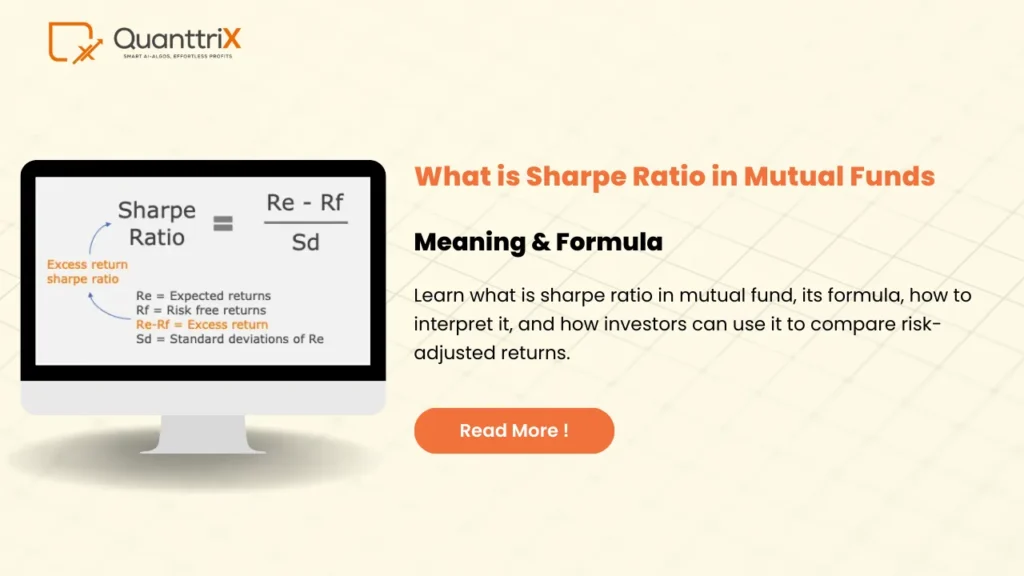
The Sharpe Ratio in Mutual Fund Formula is:
Sharpe Ratio=(FundReturn–Risk−FreeReturn)StandardDeviation\text{Sharpe Ratio} = \frac{(Fund Return – Risk-Free Return)}{Standard Deviation}Sharpe Ratio=StandardDeviation(FundReturn–Risk−FreeReturn)
What Each Term Means:
- Fund Return: The average fund generated by the mutual fund.
- Return on a safe investment (typically government bonds) Risk-Free Return:
- Standard Deviation: Volatility (risk) Measure.
Sharpe Ratio Example
Assume:
- Mutual Fund A return = 15%
- Risk-free return = 6%
- Standard deviation = 10%
SharpeRatio=(15–6)÷10=0.9Sharpe Ratio = (15 – 6) ÷ 10 = 0.9SharpeRatio=(15–6)÷10=0.9
This means the fund generates 0.9 units of excess return for every unit of risk.
Now compare with another fund.
- Mutual Fund B return = 13%
- Risk-free return = 6%
- Standard deviation = 6%
SharpeRatio=(13–6)÷6=1.17Sharpe Ratio = (13 – 6) ÷ 6 = 1.17SharpeRatio=(13–6)÷6=1.17
Even though Fund B has lower returns, it delivers better risk-adjusted performance.
What is a Good Sharpe Ratio?
Sharpe Ratio | Interpretation |
Below 0.5 | Weak risk-adjusted performance |
0.5 – 1.0 | Average |
1.0 – 1.5 | Good |
1.5 – 2.0 | Very good |
Above 2.0 | Excellent (rare & exceptional) |
Sharpe Ratio of greater than 1 in Indian mutual funds in the equity market is healthy in an extended period.
Real-Life Mutual Fund Example
Imagine two large-cap mutual funds:
Fund X
- 5-year CAGR: 14%
- High volatility during market corrections
- Sharpe Ratio: 0.8
Fund Y
- 5-year CAGR: 12.5%
- Smaller drawdowns
- Sharpe Ratio: 1.3
Although Fund X looks attractive at first glance, Fund Y:
- Protects capital better during crashes
- Reduces emotional stress
- Is more suitable for long-term SIP investors
This is exactly why Sharpe Ratio matters more than headline returns.
Why is Sharpe Ratio Crucial for SIP Investors?
SIP investors often stay invested for 10–20 years. Over such long periods:
- Volatility matters more than short-term returns
- Emotional discipline determines success
- Consistency beats aggression
Funds with higher Sharpe Ratios:
- Reduce panic during market crashes
- Encourage long-term investing
- Improve compounding efficiency
For retail investors, Sharpe Ratio acts as a stability filter.
Best Sharpe Ratio Mutual Funds in India
Many investors search for the best Sharpe Ratio mutual funds in India, but this approach must be used carefully.
Correct Way:
- Compare funds within the same category
- Use rolling 3-year or 5-year data
- Combine Sharpe Ratio with expense ratio and fund consistency
Wrong Way:
- Comparing equity funds with debt funds
- Using Sharpe Ratio alone
- Selecting funds purely based on past data
Sharpe Ratio is a decision-support tool, not a shortcut.
Sharpe Ratio vs Returns: Why Higher Returns Can Fool You
Consider this scenario:
Fund | Return | Volatility | Sharpe Ratio |
Fund A | 18% | Very high | 0.7 |
Fund B | 13% | Moderate | 1.4 |
Fund A may attract attention during bull markets, but Fund B is more likely to:
- Survive market crashes
- Deliver stable long-term wealth
- Suit conservative investors
Smart investors prioritise efficiency, not excitement.
Sharpe Ratio vs Other Risk Metrics
Sharpe Ratio vs Standard Deviation
- Standard deviation shows how volatile a fund is
- Sharpe Ratio shows whether volatility is rewarded
Sharpe Ratio vs Alpha
- Alpha measures outperformance vs benchmark
- Sharpe Ratio measures return per unit of risk
Sharpe Ratio vs Beta
- Beta shows sensitivity to market movement
- Sharpe Ratio measures overall efficiency
Each metric complements the others.
Limitations of Sharpe Ratio
Despite its usefulness, Sharpe Ratio has limitations.
- Assumes returns follow a normal pattern
- Penalises upside volatility as well
- Not ideal for funds with irregular returns
- Backward-looking by nature
This is why professional investors never use Sharpe Ratio in isolation.
How Often Should You Check Sharpe Ratio?
For mutual fund investors:
- Review annually
- Track rolling 3-year & 5-year Sharpe Ratios
- Ignore short-term fluctuations
Consistency over time matters more than one-year spikes.
Who Should Use Sharpe Ratio the Most?
Sharpe Ratio is especially useful for:
- Long-term SIP investors
- Conservative equity investors
- Retirement planners
- Portfolio rebalancing decisions
This risk-aware approach is strongly emphasised in investor education by Trendy Traders Academy, where sustainability is valued over speculation.
Common Mistakes Investors Make With Sharpe Ratio
- Chasing the highest Sharpe Ratio blindly
- Ignoring fund category
- Using 1-year data only
- Ignoring expense ratios
- Treating Sharpe Ratio as a guarantee
Sharpe Ratio guides decisions-it does not replace judgment.
Conclusion
The best sharpe ratio mutual funds in India transfers investing from excitement to intelligence. It makes investors remember that returns realized without discipline are likely to be lost as fast.
The Sharpe Ratio by emphasizing on risk-adjusted returns can help you to choose mutual funds that ensure that you not only increase wealth but also safeguard it in challenging times. It is particularly effective when combined with such measures as standard deviation, alpha, and portfolio quality.
What is sharpe ratio in mutual fund? The Sharpe Ratio Meaning in Mutual Fund is a reality check to Indian investors who have to operate in the fluctuating markets. It promotes long-term thinking, patience, and consistency.
FAQ'S
What is sharpe ratio in mutual fund?
The Sharpe Ratio Meaning in Mutual Fund is a measure of the risk-adjusted performance of a mutual fund, which helps to determine excess performance in a mutual fund divided by its volatility in relation to the risk-free rate.
What is a good Sharpe Ratio on mutual funds?
The best sharpe ratio mutual funds in India will be a Sharpe Ratio of 1.0 and above is good and above 1.5 is a very strong Sharpe Ratio.
Can Sharpe Ratio be negative?
Yes. A negative Sharpe Ratio implies that the fund is not performing well even without any risk.
Should beginners make use of Sharpe Ratio?
Yes. It is amongst the easiest ways of beginners to comprehend risk versus reward.
Do greater Sharpe Ratio always make good?
No, usually, however, when the funds are compared only within the same category and at the same period of time.
What is the Sharpe Ratio in Mutual Fund Formula?
The Sharpe Ratio in Mutual Fund Formula is Sharpe Ratio = (FundReturn–Risk−FreeReturn)StandardDeviation\text{Sharpe Ratio} = \frac{(Fund Return – Risk-Free Return)}{Standard Deviation}Sharpe Ratio=StandardDeviation(FundReturn–Risk−FreeReturn)