
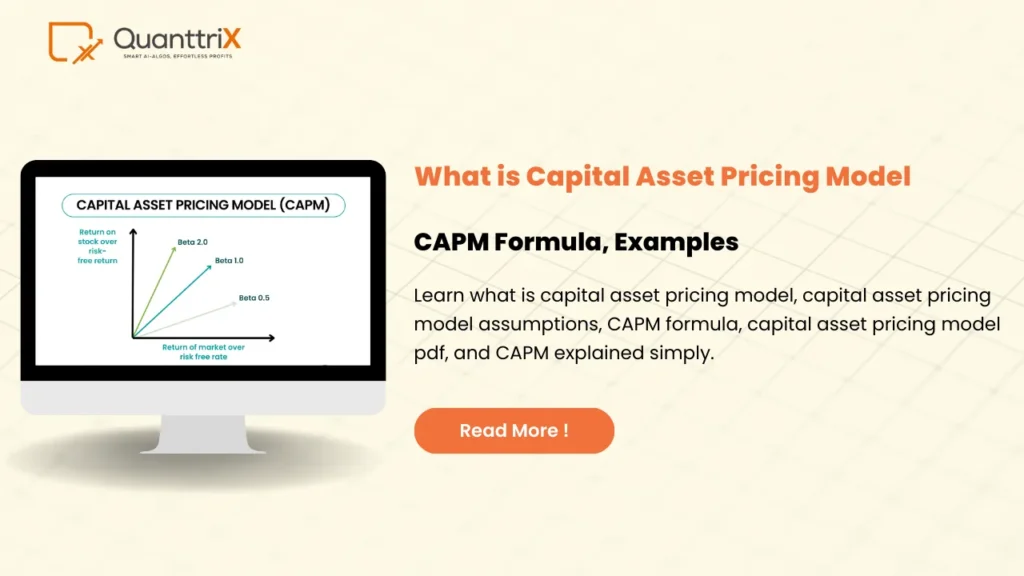
What is Capital Asset Pricing Model (CAPM) Formula, Examples
The Capital Asset Pricing Model (CAPM) is a financial model which is utilized to estimate the expected investment performance through the relationships between risk and investment returns. It is used to enable investors to know the reasonable amount of return to expect on a stock, mutual fund or portfolio depending on the market risk associated with it.
Depending on the financial markets, certain investments would give a stable pay off whereas others would varyingly give one a big fluctuation. CAPM provides a methodology to assess such uncertainty and determine whether an investment is worth taking the risk.
In this guide we’ll discuss what is capital asset pricing model, capital asset pricing model assumptions, capital asset pricing model formula, capital asset pricing model.
What is Capital Asset Pricing Model (CAPM)?
The Capital Asset Pricing Model (CAPM) is described as a method of making estimates regarding future returns of a given asset given that it is exposed to systematic risk of the asset, the returns in the market and the risk free rate of return.
In simple straightforward terms, CAPM advises investors to make sure that they require the minimum amount of return on an investment based on the level of risk that they are taking. CAPM has seen widespread application in equity valuation, portfolio management, corporate finance and investment analysis because of its simplicity and rational form.
CAPM holds that investors have to be compensated in terms of:
- The time value of money, and
- The market risk involved in the investment.
The model explains how systematic risk (market-wide risk) affects expected returns and is widely used in:
- Stock valuation
- Portfolio planning
- Mutual fund evaluation
- Corporate finance decisions
- Cost of equity calculation
What is Capital Asset Pricing Model? Why Is CAPM Important?
CAPM is an important instrument in financial decision making among investors and companies.
1. Favors Smarter Investment Decisions.
The use of CAPM enables investors to assess the expected returns against the risk and therefore makes investments that have a reasonable compensation.
2. Focuses on Relevant Risk
The model focuses on systematic risk, which can not be removed through diversification, and therefore, risk evaluation will be more feasible.
3. One-Helps in Portfolio Construction.
Through the contribution of every stock to the total portfolio risk, investors are able to form balanced and optimal portfolios.
4. Helps in the estimation of Cost of Equity.
The CAPM is useful in businesses to determine the cost of equity capital, which is necessary in the project appraisal and the valuation of the company.
Core Principle Behind CAPM
The fundamental idea behind CAPM is Higher the risk, higher should be the expected return.
If investors are exposed to greater market volatility, they naturally expect additional compensation. CAPM quantifies this relationship using beta (β), which measures market risk.
What is Capital Asset Pricing Model Formula?
The standard Capital Asset Pricing Model Formula is:
Expected Return = Risk-Free Rate + Beta × (Market Return − Risk-Free Rate)
Mathematically: E(R) = Rf + β (Rm − Rf)
Where:
- E(R) = Expected return of the asset
- Rf = Risk-free rate
- β (Beta) = Systematic risk measure
- Rm = Expected market return
Explanation of Capital Asset Pricing Model Formula Components
1. Risk-Free Rate (Rf)
The risk-free rate is the return generated from investments with negligible risk. Government securities are typically used as proxies.
In India, the 10-year Government Bond yield is commonly considered the benchmark risk-free rate.
Example: If the 10-year government bond yield is 7%, then Rf = 7%
2. Market Return (Rm)
Market return represents the average return generated by the overall stock market.
In India, popular benchmarks include:
- NIFTY 50
- Sensex
Example: If the market delivers an average return of 13%, then Rm = 13%
3. Beta (β)
Beta indicates how sensitive a stock is compared to overall market movements.
Beta Value | Meaning |
β = 1 | Moves in line with the market |
β > 1 | More volatile than the market |
β < 1 | Less volatile than the market |
β = 0 | No market correlation |
β < 0 | Moves opposite to market |
Example:
- β = 1.3 → 30% more volatile than market
- β = 0.6 → 40% less volatile
How does CAPM Work? – Step-by-Step Process
- Identify the risk-free rate
- Estimate the market return
- Find the beta value
- Apply the CAPM formula
This gives the expected return, which can be compared with actual returns to judge investment attractiveness.
Practical Example of CAPM Calculation
Given:
- Risk-Free Rate (Rf) = 7%
- Market Return (Rm) = 13%
- Beta (β) = 1.5
Step 1: Calculate Market Risk Premium
Market Risk Premium = Rm − Rf = 13% − 7% = 6%
Step 2: Apply CAPM Formula
Expected Return = 7% + 1.5 × 6%
= 7% + 9%
= 16%
Interpretation:
An investor should ideally expect 16% return to justify the risk of investing in this stock.
Market Risk Premium Explained
The market risk premium is the extra return investors expect for choosing risky investments instead of risk-free options.
Market Risk Premium = Market Return − Risk-Free Rate
- Higher uncertainty → Higher premium
- Lower uncertainty → Lower premium
Capital Asset Pricing Model Assumptions
Capital Asset Pricing Model Assumptions operates on certain theoretical assumptions:
- Investors behave rationally
- Markets are efficient
- No taxes or transaction costs
- Equal access to information
- Investors can borrow and lend at the risk-free rate
- Portfolios are fully diversified
These Capital Asset Pricing Model Assumptions simplify calculations but differ from real market conditions.
Advantages of CAPM
- Easy to Understand: Simple formula makes calculations straightforward
- Logical Framework: Strong theoretical foundation
- Helps in Stock Valuation: Useful for identifying mispriced stocks
- Portfolio Optimization: Helps balance risk and return
- Corporate Finance Use: Standard tool for cost of equity estimation
Limitations of CAPM
- Unrealistic Assumptions: Forsakes taxes, costs and market imperfections.
- Unstable Beta: The Beta value varies constantly.
- Future Market Return Uncertainty: Difficult to determine.
- Single-Factor Approach: It does not take into account other controlling factors such as size and momentum and company fundamentals.
CAPM vs other Asset Pricing Models.
1. Fama-French Three-Factor Model.
Adds:
- Company size
- Value factor
2. Arbitrage Theorems: Pricing Theory (APT)
- It makes use of more than one market factor: many economic variables.
- CAPM has been very popular even with the alternatives because of its simplicity and clarity.
Applications of CAPM in Real Life.
- Stock Analysis: Fair expected returns estimation.
- Mutual Fund Evaluation: Performance versus expectation benchmarks.
- Corporate Finance: Project analysis and valuation.
- Portfolio Management: Investment portfolio with risk adjustments.
CAPM in the Indian Market Context
In India, CAPM is widely used by:
- Equity research analysts
- Portfolio managers
- Financial advisors
- Corporate finance professionals
Common Inputs:
- Risk-free rate → 10-year G-Sec yield
- Market return → Long-term NIFTY / Sensex returns
- Beta → NSE, BSE, financial platforms
How Reliable Is CAPM?
CAPM gives approximate expected returns, not the certain results. The real returns are determined by a number of factors including:
- Economic conditions
- Company performance
- Global market trends
- Policy changes
Therefore, CAPM is not a prediction formula but a decision support tool.
Hands-On Advice on the application of CAPM.
- Utilize long term market averages.
- Triangulation of sources of cross-check beta.
- Integrate CAPM and fundamental and technical analysis.
- Do not rely only on a single valuation model.
Conclusion
One of the most significant tools in contemporary finance is the Capital Asset Pricing Model (CAPM). It reduces complicated risks and returns into a workable formula which investors, analysts, and corporations make use of.
Despite some of its limitations, CAPM has been an important model in valuation, portfolio management, and financial decision-making. The knowledge of the CAPM helps the investor to make more rational, informed and disciplined decisions in investing.
FAQ'S
What is Capital Asset Pricing Model?
CAPM approximates the expected returns of an investment in terms of its market risk.
What is the Capital Asset Pricing Model Formula?
Expected Return = Risk-Free Interest + Beta × (Market Return -Risk-Free Interest).
Why is beta important in CAPM?
Beta is used to determine the sensitivity of an asset to a market movement.
Is CAPM too difficult to follow?
Yea, CAPM is easy and assists the beginners to comprehend the risk-reward relationships.
Is CAPM applicable to the evaluation of mutual funds?
Yes, it assists in determining whether the returns of the fund are worth the risk.
Does CAPM guarantee profits?
No. CAPM can only give estimates and not guaranteed returns.

