
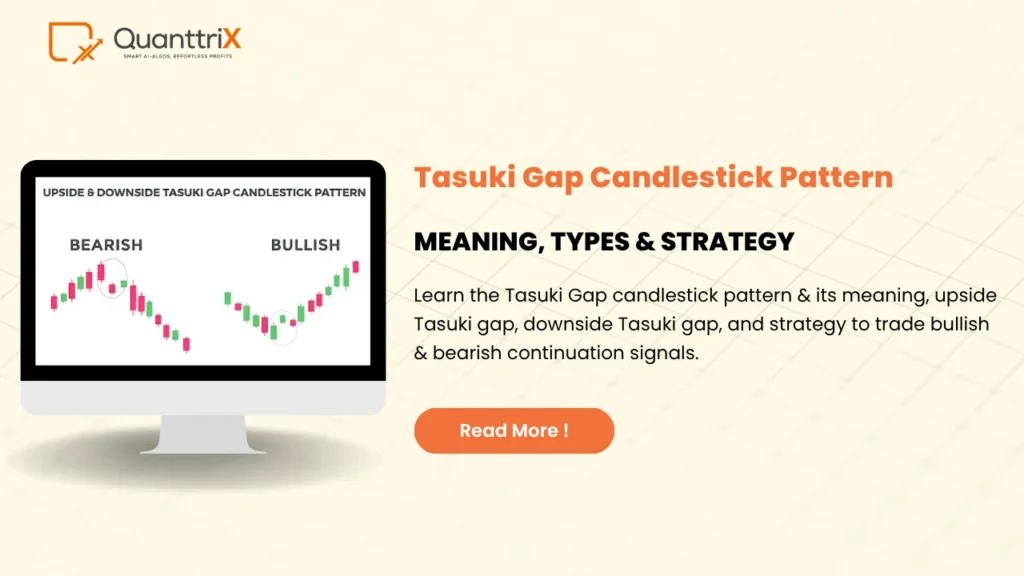
Tasuki Gap Candlestick Pattern: Meaning, Types & Strategy
When it comes to trading, candlestick patterns are like the language of price action. Each candle tells a story – of emotions, momentum, and intent in the market. Among hundreds of patterns, the Tasuki Gap candlestick pattern stands out for one specific reason – it helps traders spot trend continuation in a simple yet powerful way.
Unlike reversal patterns that indicate a shift in market sentiment, the Tasuki Gap signals that the ongoing momentum (whether bullish or bearish) is likely to continue. It’s a pattern that captures a brief pause in the market – a small rest before the next move in the same direction.
What is a Tasuki Gap in Trading?
A Tasuki Gap is a three-candle continuation pattern that indicates a strong ongoing trend – either bullish or bearish. If a gap forms between two candles, this will appear followed by a third candle that moves slightly against the trend but fails to close the gap.
The Tasuki Gap can occur in both uptrends and downtrends and is categorized into two types:
- Upside Tasuki Gap (Bullish continuation)
- Downside Tasuki Gap (Bearish continuation)
How the Tasuki Gap Candlestick Pattern Works
The pattern’s strength lies in its structure and sequence of price action.
Here’s how it unfolds:
- The market is already trending (either up or down).
- A gap forms in the direction of the trend – showing momentum.
- Trying to push against that direction is the work of the next candle, attempting to close the gap.
- Confirming the continuation of the existing trend, the gap remains unfilled.
Tasuki Gap Psychology
Candlestick patterns are more than shapes – they represent trader psychology.
- In an upside gap, buyers have been in control for some time. When the market gaps upward, it shows fresh enthusiasm. The following small bearish candle reflects short-term profit booking. But since the gap remains unfilled, it proves that bulls are still confident and ready to push prices higher.
- In a downside gap, the opposite happens. Sellers dominate, causing a downward gap. When buyers attempt to lift prices, their effort falls short – confirming that the bearish trend remains powerful.
So, the Tasuki Gap is essentially a battle between continuation and correction, where the trend eventually wins.
Types of Tasuki Gap Patterns
- Tasuki Gap Upside – Continuation of an uptrend will be signalled.
- Tasuki Gap Downside – Signals continuation of a downtrend.
Both serve as reliable confirmations that the ongoing trend has more momentum left.
Upside Tasuki Gap Explained
During a bullish trend, the Upside Gap will be formed and consists of three candles:
- First Candle: strong buying will be indicated by a long bullish candle.
- Second Candle: Showing buyers are still active that opens with a gap up by another bullish candle.
- Third Candle: A small bearish candle that attempts to close the gap but doesn’t succeed.
This pattern suggests that the bulls are only taking a short pause before driving the price higher again.
Think of it as a “springboard” – the market dips slightly, only to bounce even higher.
How to Trade Upside Tasuki Gap
Step 1: Identify the Uptrend: Establishment of elevated peaks and lows should be verified by the market trends. For confirmation, you can use moving averages (e.g., 50-day EMA).
Step 2: Identify the Pattern: With a visible gap between them, look for two consecutive bullish candles and followed by a small bearish candle that does not close the gap.
Step 3: Verify the Trend: By using volume analysis – the second bullish candle should have higher volume than average, confirming strong participation.
Step 4: Point of Entry: Put a purchase order just above the third candle’s high.
Step 5: Stop-Loss Placement: Set a stop loss slightly below the third (bearish) candle’s low, to safeguard your trade.
Step 6: Establishing a Goal: Aim for 1.5x-2x your risk, or hold until the trend weakens-signaled by a reversal pattern or RSI divergence.
Downside Tasuki Gap Explained
The Downside Tasuki Gap candlestick pattern forms during a bearish trend and mirrors the upside version.
- First Candle: The first candle will be a bearish one.
- Second Candle: This bearish candle reinforces selling pressure by opening with a gap down.
- Third Candle: A bullish candle that makes an unsuccessful attempt to close the gap.
How to Trade Downside Tasuki Gap
Here’s a step-by-step method to trade the downside Gap:
Step 1: Confirm the Downtrend: Whether the prices are lower or higher, verify with the market trend.
Step 2: Identify the Pattern: Two consecutive bearish candles can be spotted with a visible gap down, followed by a small bullish candle.
Step 3: Validate the Pattern: To confirm the continuation signal, use RSI below 50 or MACD bearish crossover.
Step 4: Point of Entry: Put a purchase order just above the third candle’s high.
Step 5: Stop-Loss Placement: Above the high of the third (bullish) candle, put a stop loss.
Step 6: Target: Target 1.5-2x of your risk or wait for the next support level.
Key Characteristics of a Tasuki Gap Candlestick Pattern
- During strong trends (bullish or bearish), it will be occured.
- A gap between the first two candles will always be involved.
- The third candle moves against the trend but fails to fill the gap.
- Works best when supported by volume and indicator confirmation.
- Indicates continuation rather than reversal.
Difference Between Upside and Downside Gaps
Feature | Tasuki Gap (Upside) | Tasuki Gap (Downside) |
Trend Direction | Bullish | Bearish |
First Two Candles | Bullish | Bearish |
Gap Type | Gap Up | Gap Down |
Third Candle | Small Bearish | Small Bullish |
Implication | Continuation of uptrend | Continuation of downtrend |
This comparison makes it easier to identify which side of the market you’re dealing with.
Technical Guide for Verifying Tasuki Gap Patterns
- Moving Averages (MA): Bullish continuation will be supported when the price above MA; below MA supports bearish continuation.
- RSI (Relative Strength Index): RSI > 50 for upside gaps, < 50 for downside gaps.
- MACD (Moving Average Convergence Divergence): With the gap direction, look for alignment.
- Volume: Rising volume on the first two candles signals strong conviction.
Using two or more of these together increases accuracy.
Common Mistakes Traders Make with Tasuki Gaps
- Trading in Sideways Markets: The pattern only works in strong trending phases.
- Ignoring Volume: Without volume confirmation, gaps can be misleading.
- Forcing the Pattern: Sometimes traders “see” gaps where none exist – patience pays.
- Skipping Risk Management: Always use stop losses; no pattern is foolproof.
- Lack of Context: Combine with support/resistance and market structure for best results.
Real-Life Example of Tasuki Gap Pattern
Imagine a stock like Infosys in a strong uptrend.
- On Day 1, the price closes with a large bullish candle at ₹1,550.
- On Day 2, it opens higher at ₹1,565 and closes at ₹1,580, leaving a gap between the two candles.
- On Day 3, the price opens at ₹1,582 and closes slightly lower at ₹1,570 – but the gap from ₹1,550 to ₹1,565 remains unfilled.
This is a perfect Upside Gap – it confirms the continuation of bullish momentum.
Advantages and Limitations of the Tasuki Gap Pattern
Advantages
- Provides early confirmation of trend continuation.
- Simple and visually easy to identify.
- Can be combined with other indicators for higher accuracy.
- Works well in volatile and trending markets.
Limitations
- Rare occurrence; not seen daily on most charts.
- False signals can occur in low-volume conditions.
- Requires contextual confirmation for reliability.
Best Practices for Using Tasuki Gap in Trading
- Use the pattern on higher timeframes (4H, daily) for better reliability.
- Always check the overall trend direction with a moving average.
- Combine with momentum indicators for confirmation.
- Don’t ignore volume spikes – they validate the breakout strength.
- Manage your risk-to-reward ratio carefully.
Remember: Tasuki Gaps are not predictions – they’re confirmations of existing momentum.
Conclusion
The Tasuki Gap candlestick pattern is a powerful way to confirm ongoing trends. Whether you’re looking at an upside gap in a bullish phase or a downside gap candlestick pattern during a bearish move, this setup provides valuable insight into price continuation.
However, no pattern guarantees success. Combine it with strong risk management, trend analysis, and indicator confirmation. When used properly, the Tasuki Gap can enhance your trading accuracy and confidence.
FAQ'S
What is a Tasuki Gap candlestick pattern?
It’s a three-candle continuation pattern where a gap forms in the trend, followed by a candle that moves against it but fails to close the gap.
Is the Tasuki Gap a reversal or continuation pattern?
It’s a continuation pattern – confirming that the existing trend will likely proceed.
How reliable is the Tasuki Gap?
It’s moderately reliable when combined with technical indicators and volume confirmation.
Can Tasuki Gaps appear in any market?
Yes, they can appear in stocks, forex, commodities, and even cryptocurrency markets.
Can beginners trade the Tasuki Gap pattern?
Yes, it’s simple to understand and identify, making it beginner-friendly.