
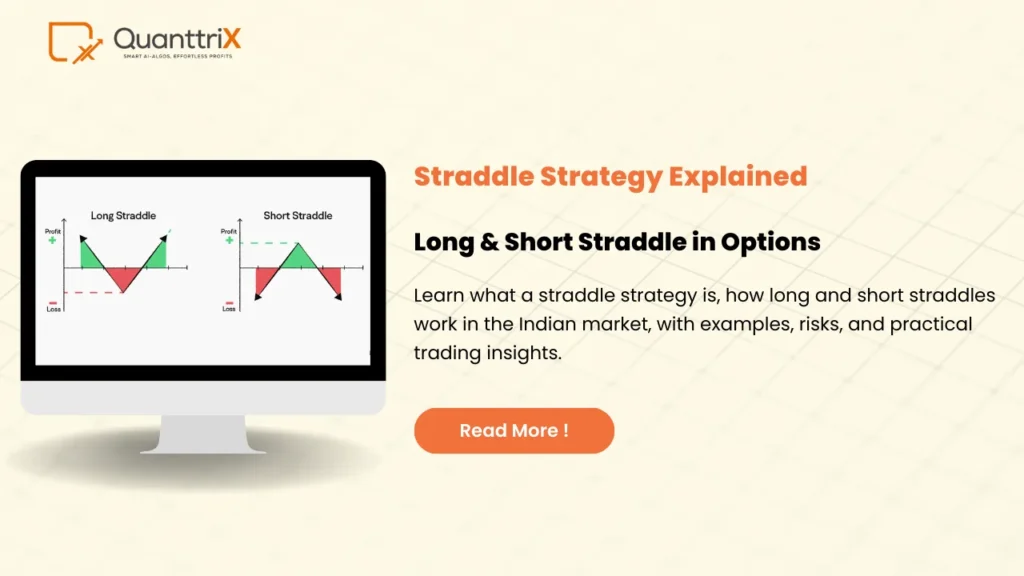
Straddle Strategy Explained: Long & Short Straddle in Options
Options trading is not merely based on the speculation of whether the market will experience an upward or downward trend. In a myriad of practical cases, dealers are more concerned with the extent to which the market will move rather than the direction. This is the very point where the straddle strategy comes in with strength.
Straddle strategies are highly popular in the Indian stock market, particularly in index options, whereby both the professional traders and the institutions, as well as beginners, apply it after having the understanding of volatility. Straddles are important whether it be a budget day, RBI policy announcement or expiry session.
This guide will answer the question of what is straddle, what is long straddle, what is short straddle, and how straddle strategy works in the Indian markets in the form of simple examples and understanding.
What Is Straddle in Options Trading?
Straddle is an option trading strategy where the trader acquires both a call and a put option at the same strike price and expiry. Straddle strategy is an option that entails purchasing or selling a call and a put in the same price. It is applied when the traders anticipate high or low volatility and not directional in particular in the Indian indices such as NIFTY and BANKNIFTY.
The key idea is simple:
- Betting on direction is not done.
- Betting on volatility is done.
- A straddle would be advantageous when the market is looking to make a large move (long straddle) or when the market is in a range (short straddle).
- Securities that are typically traded in India include straddles.
- National Stock Exchange of India (NSE).
- BSE
And mostly in:
- NIFTY 50
- BANK NIFTY
Why is the Straddle Strategy Popular in India?
Indian markets are known for event-driven volatility. Some common triggers include:
- Union Budget
- RBI monetary policy
- Weekly and monthly expiry
- Global cues (US inflation, Fed meetings)
- Large gap-up or gap-down openings
During such times, predicting direction is difficult – but volatility is almost guaranteed. That’s why straddles are heavily used by Indian traders.
What is a Long Straddle?
A long straddle involves buying:
- 1 At-the-Money (ATM) Call Option
- 1 At-the-Money (ATM) Put Option
Both options have:
- Same strike price
- Same expiry date
What is a Long Straddle?When Do Traders Use?
You use a long straddle when you expect:
- A big move in the market
- But don’t know the direction
This strategy profits from high volatility.
Long Straddle Example (Indian Market)
Assume:
- NIFTY is trading at 22,000
- Weekly expiry options
You buy:
- 22,000 CE at ₹120
- 22,000 PE at ₹110
Total premium paid = ₹230
Profit Scenarios:
- If NIFTY moves above 22,230 → profit
- If NIFTY moves below 21,770 → profit
Loss Scenario:
- If NIFTY expires near 22,000, both options lose value
Maximum loss = ₹230 (premium paid)
Profit potential = Unlimited
Pros of Long Straddle
- Limited risk
- Unlimited profit potential
- Direction-neutral strategy
- Ideal for news or event days
Cons of Long Straddle
- Requires strong volatility
- Time decay (theta) works against you
- Expensive during high IV periods
What is Short Straddle?
A short straddle is the exact opposite of a long straddle.
Here, you sell:
- 1 ATM Call Option
- 1 ATM Put Option
Same strike price and expiry.
What is Short Straddle?When Do Traders Use?
You use a short straddle when:
- You expect low volatility
- Market is likely to stay range-bound
This strategy is commonly used by experienced traders and option sellers in India.
Short Straddle Example (Indian Market)
Assume:
- BANKNIFTY at 46,000
You sell:
- 46,000 CE at ₹220
- 46,000 PE at ₹210
Total premium received = ₹430
Profit Scenario:
- BANKNIFTY expires near 46,000
Loss Scenario:
- Big move in either direction
Maximum profit = ₹430
Maximum loss = Unlimited
Pros of Short Straddle
- High probability strategy
- Benefits from time decay
- Profitable in sideways markets
Cons of Short Straddle
- Unlimited risk
- Requires margin
- Not suitable for beginners
- Risky during events
Long Straddle vs Short Straddle (Comparison Table)
Feature | Long Straddle | Short Straddle |
Market View | High volatility | Low volatility |
Risk | Limited | Unlimited |
Reward | Unlimited | Limited |
Suitable For | Beginners | Experienced traders |
Time Decay | Negative | Positive |
Capital Requirement | Low | High |
Key Greeks in Straddle Strategy
Understanding option Greeks is crucial:
- Delta: Near zero initially (direction-neutral)
- Gamma: High (benefits from big moves)
- Theta: Negative for long straddle, Positive for short straddle
- Vega: Long straddle benefits from rising volatility, Short straddle suffers from rising volatility
When NOT to Trade a Straddle
Avoid straddles when:
- IV is extremely high (for long straddle)
- Major event results are already priced in
- Liquidity is low
- You don’t have a risk management plan
Risk Management Tips for Indian Traders
- Always define maximum loss
- Use stop-loss in short straddle
- Avoid overnight short straddles near events
- Prefer index options over stock options
- Track India VIX before entering trades
Common Mistakes Traders Make
- Buying long straddles when IV is already high
- Holding short straddles during announcements
- Ignoring margin requirements
- Overtrading weekly expiry
Conclusion
The straddle strategy is among the most feasible and commonly applied options strategies in the Indian market. It gives traders the ability to engage in volatility as opposed to direction that is usually more realistic in uncertain market conditions.
A long straddle is the best when you have a good move but are not sure in which direction the market is going whereas a short straddle is best suited in stable but sideways markets where risk is monitored in a disciplined manner.
To Indian traders, learning straddles will be a solid base to options trading, analysis of volatility, and professional risk management. In the right hands, straddles can change the thinking process about approaching the market, as opposed to making a guess about direction to trade.
FAQ'S
What is straddle of options trading?
A straddle is a trading technique in which a trader simultaneously sells and buys a call and a put option at the same spot and expiry to traverse volatility.
What is a long straddle?
A long straddle is a purchase of both a call and a put to enjoy a large movement in either direction in the market.
What is short straddle?
A short straddle is the sale of both a call and a put option in order to gain premium when the market remains in a range bound.
Can straddle be done with beginners?
Long straddles are easy to use as there is not much risk involved and short straddles are not easy as they are more suited to experienced traders.
Long or short straddle, which is the best?
It is subject to the volatility of the market. Long straddle is preferred by high volatility, short straddle is by low volatility.

