
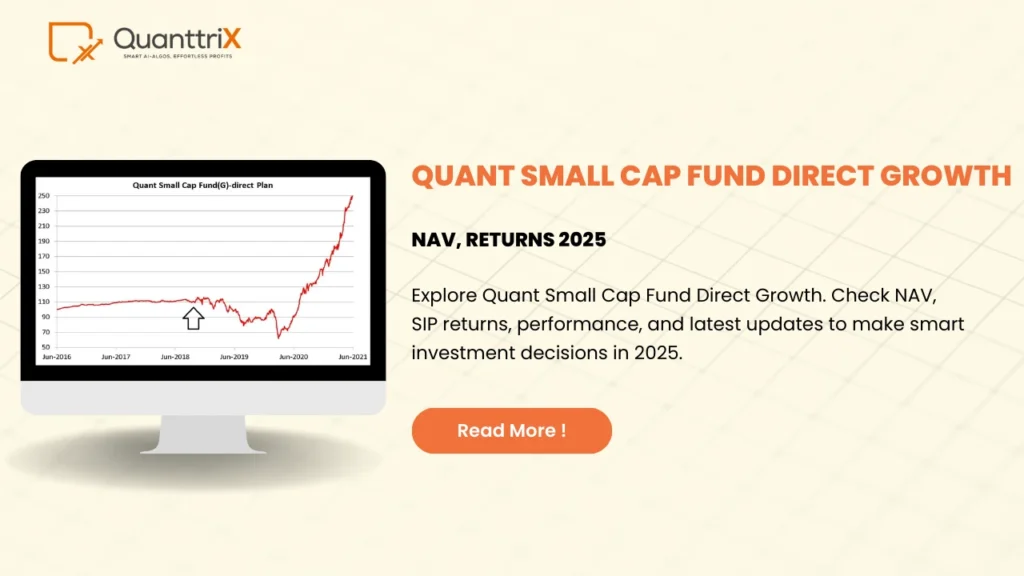
Quant Small Cap Fund Direct Growth: A 2025 Story for Aspiring Investors
Why Small Cap Funds, Why Quant, Why Now?
Imagine you’re chatting with your cousin at a family get-together. She’s a techie, but now she’s obsessing over small cap funds. Her phone screen glows with “quant small cap fund direct growth”—and suddenly, everyone leans in. What’s so special about this fund? Why are buzzwords like “direct growth” and “regular growth” flying around in every finance WhatsApp group?
If you’ve ever wondered whether the “Quant Small Cap Fund review” hype is for real—or if you’re confused between “direct” and “regular” plans—this blog is for you. Let’s break down everything, in plain English, with real examples, simple tables, and no jargon.
The Basics—What is Quant Small Cap Fund?
Let’s start at square one:
- Category: Small cap funds invest in smaller, nimble companies with the potential to skyrocket—sometimes even double or triple in a few years.
- About Quant: Quant is a new-age asset manager that’s built a reputation for gutsy, tactical moves. Unlike many “play it safe” rivals, Quant funds are known for bold, active stock-picking, especially in the small cap segment.
If you search “quant small cap fund regular growth” or “quant small cap fund direct growth” you’ll spot two options—both invest in the same stocks, but cost structures and returns differ a bit (more on this in a moment).
Direct Growth vs Regular Growth—Which One Fits You?
Let’s imagine Mehul, a young engineer researching mutual funds online. He clicks on “quant small cap fund direct growth” and “quant small cap fund regular growth”—but what’s the real difference?
- Direct Growth: Buy directly from Quant (no distributor), lower expense ratio, higher net returns.
- Regular Growth: Buy through an advisor/broker; pays them commission, so returns are trimmed by the higher annual fee.
Direct vs Regular at a Glance
Feature | Direct Growth | Regular Growth |
Purchase Path | Direct from AMC (Quant) | Through agent/advisor/broker |
Expense Ratio | Lower (about 0.7% in Sept 2025) | Higher (about 1.6% in Sept 2025) |
Commission Paid | None | Embedded in annual cost |
Returns | Usually a bit higher (long run) | Slightly lower |
Who Chooses? | DIY, online-savvy investors | Investors needing hand-holding |
Performance Snapshot—Quant Small Cap Fund Direct Growth 2025
Let’s get to the numbers. Quant Small Cap Fund direct growth has been a showstopper, making headlines for stunning returns over the past few years.
Quant Small Cap Fund Direct Growth—Performance
Years | CAGR Returns (%) (as of Sept 2025) |
1 | -8.4 |
3 | 24.4 |
5 | 36.8 |
Since Launch | ~24 |
Minimal investment via direct plan: ₹5,000 (lump sum) or ₹1,000 (SIP).
What does this mean for a new investor? If you’d started a ₹5000 SIP in 2020, you’d be smiling. Even with bumps, the long-term trend has been rewarding.
Quant Small Cap Fund Regular Growth—How Does It Stack Up?
Suppose you went through a trusted family advisor or broker, you’d end up with the “quant small cap fund regular growth” version. Performance is similar, but slightly lower after fees.
Regular vs Direct—Returns Comparison
Year | Direct Plan Growth (%) | Regular Plan Growth (%) |
2022 | 36.4 | 35.1 |
2023 | 34.8 | 33.0 |
2024 | 24.1 | 22.3 |
The lesson? Lower costs, over time, make a visible impact. For hands-on investors, quant small cap fund direct growth offers the edge. But for those who value advice and easy setup, the quant small cap fund regular plan keeps things simple.
Quant Small Cap Fund Review—What Makes It Stand Out?
What’s Unique About Quant’s Small Cap Style?
- Aggressive, research-driven stock picking: Not afraid to churn portfolio if sector or stock momentum shifts.
- Heavy focus (30%+) on financials, manufacturing, and sunrise sectors like specialty chemicals or mid-tier IT.
- Tactical asset allocation—moves quickly between cash and stocks during market volatility.
- Managed by experienced, nimble fund managers who believe in active risk management.
Quant Small Cap Fund—Current Top Holdings (2025)
Stock | Sector | Portfolio % |
Reliance Industries Ltd | Diversified | 9.2 |
Jio Financial Services | Financial Services | 6.5 |
Specialty Chemical Cos | Chemicals | 5–7 |
Mid-cap IT Platform | Tech | 5–6 |
PSU Banks | Banking | 8–10 |
Why Are Investors Flocking to Quant Small Cap Fund Direct Growth?
Meet Geeta, a first-time mutual fund investor. High FD rates have fallen, and she wants her money to grow faster. Seeing “quant small cap fund review” headlines everywhere, Geeta does her homework:
- She compares 5-year returns and finds Quant at the top of the pack.
- She checks volatility (risk)—note small cap funds can be roller-coasters!
- She reads about portfolio shifts and high turnover and feels comfortable if the fund manager is proactive.
Result: Geeta starts a SIP in quant small cap fund direct growth—committing to a 7-year marathon, not a 1-year sprint.
Quant Small Cap Fund vs Peers (5Y Performance)
Fund Name | 5Y CAGR (%) | Risk Level | 2025 AUM (₹ Cr) |
36.8 | Very High | 28,758 | |
34.0 | Very High | 64,821 | |
32.3 | Very High | 36,294 | |
27.4 | Very High | 14,561 |
Past returns don’t guarantee future performance, but they do reveal long-term fund quality!
Quant Small Cap Fund Direct Growth vs Regular Growth—Points to Consider
- Plan for the long-term: Small caps can be volatile—aim for 5+ years minimum.
- Review fees & performance: Cheaper expense ratio makes a difference if you invest via direct plan.
- Diversify smart: Don’t put all eggs in this basket; small cap funds should be a percentage (not the bulk) of your portfolio.
- Recheck quant small cap fund review annually—fund management style is active, so sector focus and returns move over time.
Risks and Drawbacks—Keep It Real
- High volatility: Don’t invest funds that you might need urgently.
- Manager churn or style drift: If Quant’s famous active management style changes, so might returns.
- Sector exposure risk: If one sector the fund is overweight in tanks, NAV may feel pressure.
Scenarios—Who Should Pick Which Plan?
You might prefer quant small cap fund direct growth if:
– You’re DIY, online-savvy, want to maximize long-term returns, and don’t need advisor hand-holding.
You might stick with quant small cap fund regular growth if:
– You trust an advisor, want annual reviews, and value convenience even after considering higher annual fees.
Either way, both versions give exposure to the same powerful portfolio.
How to Invest—Direct Growth or Regular Plan?
Easy Steps to Invest
Mode | Steps | Why Choose? |
Direct Plan | Visit Quant Mutual Fund’s website, complete KYC, buy online | Lower cost, more money for you |
Regular Plan | Contact your advisor/distributor, fill the form or invest via brokerage platform | Help and review included |
Conclusion: Is Quant Small Cap Fund Direct Growth Right for You?
For investors like Mehul and Geeta, quant small cap fund direct growth is an exciting gateway to small cap companies—risky, yes, but with that risk comes rare potential for high reward. If you crave adventure, accept volatility, and want sharper long-term growth, this plan is your ticket.
For those preferring comfort and guidance, quant small cap fund regular growth or quant small cap fund regular stays reliable. Whichever you pick, read regular “quant small cap fund reviews,” keep your portfolio diverse, and remember—the journey to wealth is a marathon, not a sprint.
FAQ'S
What’s the minimum investment?
For both direct and regular plans, typically ₹5,000 lump sum or ₹1,000 monthly SIP.
How risky is it?
Very high. Small caps surge and tumble more than larger companies. Ideal for investors with patience and strong nerves.
What’s the typical lock-in?
No lock-in, but a 1% exit load applies if redeemed before 1 year.
How do I check qualitative reviews?
Search for “quant small cap fund review” on Groww, Value Research, and MoneyControl for expert opinions and user experiences.
Can I switch from regular to direct?
Yes, you can switch by submitting a request—this can help cut annual costs and improve net returns.