
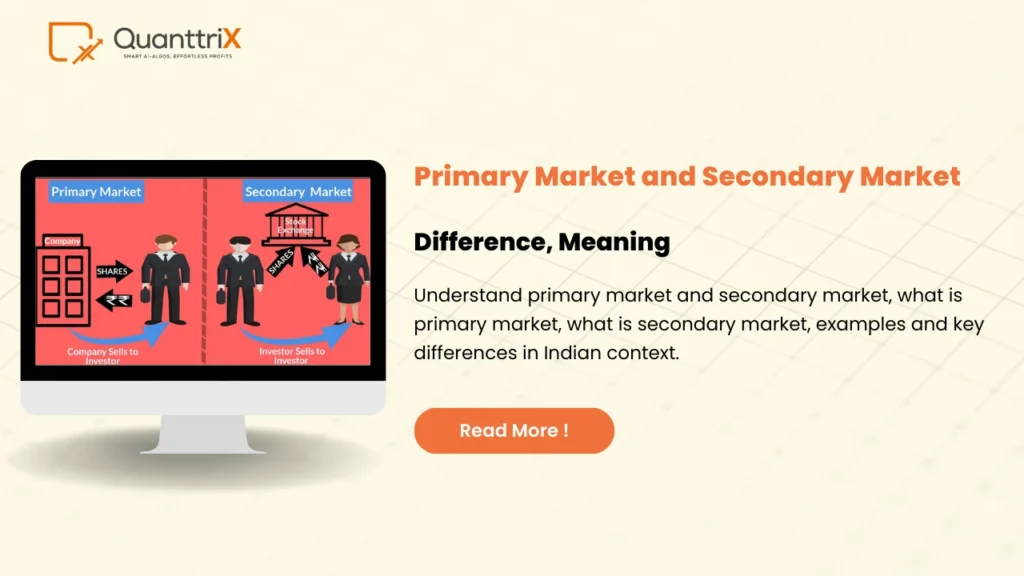
Primary Market and Secondary Market: Difference, Meaning
Every investor in India interacts with the stock market, but not everyone understands how capital actually flows. When a company raises funds through an IPO, it happens in one market. When you buy or sell shares on the stock exchange, it happens in another. These two are referred to as the primary and secondary market.
Knowledge of the primary and secondary market is a prerequisite to any person who intends to engage in equities, IPOs or long term wealth generation. The divergence does not only exist at technical level; it has a direct effect on risk, liquidity, pricing and investment strategy.
The following step by step guide of Trendy Traders Academy will cover what is primary market, what is secondary market, how they work in the Indian ecosystem and how retail investors can be involved in it. We will also compare the primary market and secondary market using structured examples from India.
What Is Primary Market?
The primary market is where new securities are issued by a company to raise capital for the first time.
What is Primary Market Meaning
In simple terms:
- Company issues new shares
- Investors subscribe to those shares
- Funds go directly to the company
This is the first point of sale of securities.
How the Primary Market Works in India?
In India, companies raise capital in the primary market through:
- Initial Public Offering (IPO)
- Follow-on Public Offering (FPO)
- Rights Issue
- Preferential Allotment
- Private Placement
A company can issue an IPO when it wants to expand, reduce debt, or raise funds to fund a new project.
For example:
If an Indian technology company launches an IPO at ₹500 per share, and retail investors subscribe, the money collected goes to the company.
The shares are then listed on exchanges like:
The primary market is controlled by the Securities and Exchange Board of India (SEBI) that provides transparency and investor protection.
Features of the Primary Market
- Securities are issued for the first time
- Funds flow to the issuing company
- Price is fixed or discovered through book building
- Involves underwriting and merchant bankers
- Requires prospectus and regulatory approval
The primary market plays a crucial role in capital formation in the Indian economy.
What Is Secondary Market?
The secondary market is where investors buy and sell existing securities after they have been issued in the primary market.
What is Secondary Market Meaning
In simple terms:
- Investors trade among themselves
- Company does not receive funds
- Transactions happen on stock exchanges
For example:
After an IPO listing, when you buy shares of a company on NSE, you are participating in the secondary market.
How Does the Secondary Market Work in India?
The secondary market in India operates through stock exchanges such as:
- NSE
- BSE
Trading occurs electronically through registered brokers.
Stock market trading time in India:
- 9:15 AM to 3:30 PM (Normal session)
- 9:00 AM to 9:15 AM (Pre-open session)
Prices in the secondary market fluctuate based on:
- Demand and supply
- Company performance
- Global market cues
- Investor sentiment
What is Secondary Market Features?
- Shares are already issued
- Investors trade among themselves
- High liquidity in large-cap stocks
- Prices change continuously
- No direct capital flow to company
The secondary market provides liquidity and price discovery.
Primary Market vs Secondary Market: Key Differences
Understanding primary market vs secondary market becomes easier through comparison.
Parameter | Primary Market | Secondary Market |
Meaning | Market where new securities are issued | Market where existing securities are traded |
Fund Flow | Money goes to company | Money goes to selling investor |
Price Determination | Fixed price or book-building process | Determined by market demand and supply |
Liquidity | Limited until listing | High, especially in large-cap stocks |
Example in India | IPO subscription | Buying shares on NSE |
Risk Type | Listing risk | Market volatility risk |
Regulation | SEBI oversight on issuance | SEBI and exchange surveillance |
Practical Example: Primary Market vs Secondary Market in India
Let us understand through a simple example.
Step 1: Primary Market
An Indian manufacturing company launches an IPO at ₹300 per share. You apply for shares. If allotted, you pay ₹300 per share. The company receives this money.
Step 2: Secondary Market
After listing, the stock starts trading on NSE. Suppose the price moves to ₹350. You sell your shares. The buyer pays you ₹350. The company does not receive any money.
This explains the primary market and secondary market clearly.
Types of Instruments in Primary Market
In India, the primary market offers:
- Equity shares
- Preference shares
- Bonds
- Debentures
- Government securities
Retail investors can apply via:
- ASBA facility
- UPI-based IPO applications
Primary market participation has grown significantly in India due to increased retail investor awareness.
Primary Market vs Secondary Market: Types of Participants
Primary Market Participants
- Issuing company
- Merchant bankers
- Underwriters
- Institutional investors
- Retail investors
Secondary Market Participants
- Retail traders
- Institutional investors
- Foreign portfolio investors
- Brokers
- Market makers
Both markets together form the backbone of the Indian capital market.
Which Is Better: Primary Market vs Secondary Market?
There is no fixed answer.
Primary market is suitable for:
- Investors looking for early entry
- Long-term growth participation
- IPO listing opportunities
Secondary market is suitable for:
- Active traders
- Swing traders
- Long-term investors building portfolios
Both markets complement each other.
How Beginners Should Approach?
If you are new to the Indian stock market:
- Start with understanding IPO fundamentals
- Learn how stock exchanges operate
- Study company financials
- Avoid applying blindly for IPO hype
- Focus on disciplined trading or investing
Primary market and secondary market together provide wealth-building opportunities, but only with proper education.
Common Misconceptions
- Misconception 1: IPO always gives profit
Reality: Many IPOs list below issue price. - Misconception 2: Secondary market is gambling
Reality: It becomes speculative only without strategy. - Misconception 3: Primary market is safer
Reality: Risk exists in both markets.
Understanding fundamentals reduces mistakes.
Economic Importance of Both Markets
Primary Market:
- Enables capital formation
- Supports business expansion
- Generates employment
Secondary Market:
- Provides liquidity
- Ensures price discovery
- Builds investor confidence
India’s economic growth is closely linked to efficient functioning of both markets.
Conclusion
Every Indian investor should know the difference between primary market and secondary market. The main market is where corporations issue capital in the form of new issues such as IPOs whereas the secondary market is where investors can freely trade in such shares in the NSE and BSE.
Both markets play different complementary roles. The major market promotes capital formation and economic growth. This is because the secondary market provides liquidity, transparency and continuous price discovery. Our special interest is to create conceptual clarity – since awareness of the foundation is the initial move towards regular success in the stock market.
Regardless of the reasons why you are applying to IPOs or you are trading stocks on a daily basis, understanding what is the primary market and what is the secondary market will help you make the right decisions. Through systematic education and disciplined approach, investors would be able to utilize both markets to create wealth in the long term.
FAQ'S
What is primary market?
The main market is the one where new securities are issued where the companies raise capital by attracting investors.
What is secondary market?
Investors buy and sell the existing securities in the stock exchanges in the secondary market.
What is primary market and secondary market difference?
The company receives money in the primary market. Money in the secondary market goes to the selling investor.
Are the retail investors eligible to enter into the primary market?
Yes, the retail investors may apply to IPOs using ASBA or UPI-based applications.
Which market is riskier: primary market vs secondary market?
Both markets carry risk. The primary market has listing risk whereas the secondary market has price volatility risk.

