
Bull vs Bear Market: Meaning, 5 Differences & Full Guide
I have always been listening to statements such as the bulls are back or bears are in control of Dalal Street, especially when you have been following the Indian stock market. These are not mere financial lingo words. They jot down the very essence of the psychology of markets.
Every trader and investor must know what is bull in stock market and how it is opposite to the bear market. Is it NIFTY options trading, investing in blue-chip stocks such as Reliance or IPO application, market direction is important.
We are going to deconstruct bull meaning in stock market, bull symbol in stock market, bull vs bear market differences, and actual real life examples in India. At its conclusion, it will be apparent how you can determine the trends in the market and adjust your approach accordingly.
What is Bull in Stock Market?
A bull in the stock market is a state of the stock market or an investor who is believed to have a positive rise in the prices.
When the market is bullish:
- Stock prices trend upward.
- Investors are optimistic.
- Buying activity increases.
- The economic indicators are good.
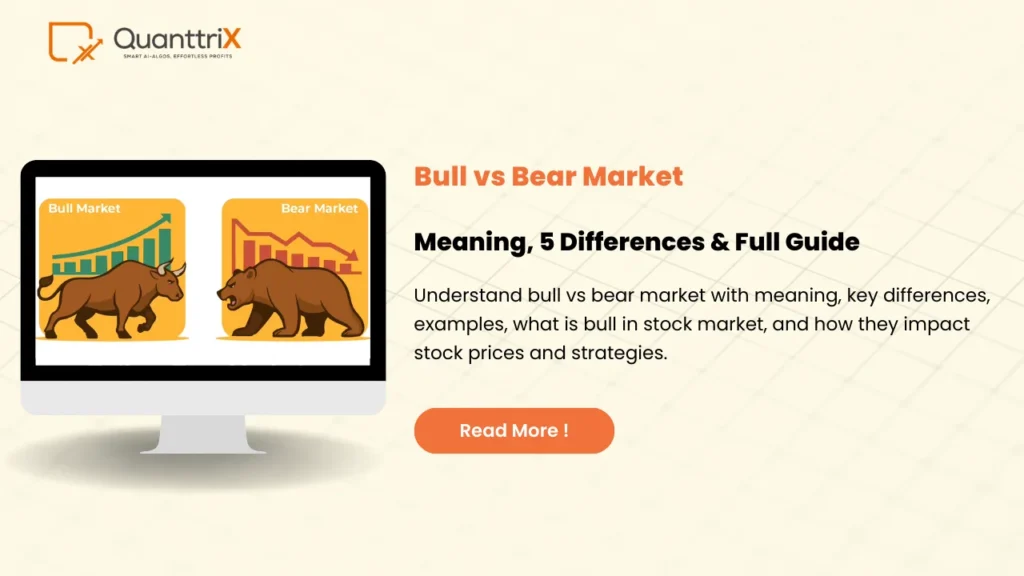
Bull market refers to the increasing values and the optimism of investors whereas bear market signifies the decreasing values and pessimism. In India, there are NIFTE and SENSEX movements describing bullish or bearish movements. Learning market cycles will aid the traders to manage risk and maximize returns.
Bull Meaning in Stock Market
A bull market refers to a time when stock prices have gone up by 20 percent and above since the lows and investor confidence is high.
As an example: Since the crash of the Indian markets in March 2020 after the COVID, the markets have recovered strongly. The NIFTY 50 went up to approximately 7,500 to more than 18,000 in a span of two years. This was among the bull markets in Indian history.
The upward movement is symbolized by the bull symbol in stock market. One of the bulls attacks by ramming his horns upwards. This upsurge is representative of the increase in prices.
A large statue of a bull outside the Bombay Stock Exchange at Mumbai in India is a symbol of hope and prosperity. On the same note, the Charging Bull sculpture in front of Wall Street in the United States is an indicator of financial power.
The bull has now been placed all over the world as an image of:
- Growth
- Strength
- Expansion
- Investor confidence
What is a Bear in Stock Market?
A bear symbolizes the pessimism in the stock market.
When the market is bearish:
- Prices decline.
- Investors sell in an aggressive mode.
- Fear dominates sentiment.
- Fears of economic slowdown increase.
There is a bear swiping down with its paws, and this is seen to represent the falling prices.
Bear Market Definition
A bear market refers to a time frame when stocks become 20 percent or more lower than the recent peak.
Example:
Indian markets crashed in 2008 at the time of the global financial crisis. The SENSEX has dropped to almost 8,000 in October 2008 compared to January 2008 when it was above 21,000. It was a terrible bear market period.
Equally, during the COVID lockdown, the initial phase of the bear market was followed by recovery in early 2020.
Bull vs Bear Market - Key Differences
Feature | Bull Market | Bear Market |
Price Direction | Rising | Falling |
Investor Sentiment | Optimistic | Pessimistic |
Economic Outlook | Strong GDP, growth | Slowdown, recession fears |
Trading Strategy | Buy on dips | Sell on rallies |
Risk Appetite | High | Low |
Understanding bull vs bear market helps traders adjust their strategies instead of fighting the trend.
Characteristics of a Bull Market in India
- Strong GDP growth (India growing above 6%)
- Positive corporate earnings
- High FII and DII participation
- Rising IPO activity
- Strong NIFTY and SENSEX momentum
Example
Between 2014 and 2017, after political stability and economic reforms, Indian markets entered a sustained bullish phase. Banking and infrastructure stocks rallied significantly.
Characteristics of a Bear Market in India
- Falling corporate profits
- High inflation
- Rising interest rates
- Global uncertainty
- Heavy FII selling
Example
The volatility experienced in the Indian markets in 2013 in the taper tantrum period was as a result of the liquidity concerns in the world market.
How to Identify Bullish and Bearish Trends?
- Index Trend: When NIFTY 50 shows an upward trend or upward movement in highs and lower levels it is said to be bullish.
- Moving Averages: When the price moves above 50 DMA and 200 DMA, then this is an indicator of bullish momentum.
- Market Breadth: In case there are greater stocks that are on the rise than the falling ones, then there are bulls at work.
- India VIX: A low volatility usually considers the bullish trend. Fear and potential bearishness are represented by high volatility.
Psychology Behind Bulls and Bears
Markets are driven by emotions:
- Greed fuels bull markets.
- Fear drives bear markets.
Retail investors often enter near market tops due to FOMO (fear of missing out) and exit near bottoms due to panic.
Professional traders focus on:
- Trend confirmation
- Risk management
- Position sizing
At Trendy Traders Academy, students are trained to trade based on structure, not emotion.
During bull phases:
- Banking
- Capital goods
- Infrastructure
- IT stocks
often outperform.
Bear Market Strategies in India
- Capital Protection: Preserve cash during uncertainty.
- Short Selling: Futures traders may short index or stocks.
- Buy Put Options: Options traders buy puts during bearish phases.
- Defensive Stocks: Pharma and FMCG often perform better in weak markets.
Why Understanding Bull vs Bear Market is Important?
- Helps manage risk.
- Improves timing.
- Prevents emotional decisions.
- Aligns strategy with market direction.
- Builds long-term wealth.
Retail investors who understand market cycles tend to outperform those who blindly follow news headlines.
Example
Imagine NIFTY is at 22,000:
Scenario 1 (Bullish):
- Strong earnings.
- Breakout above resistance.
- Traders buy call options.
Scenario 2 (Bearish):
- Global crash.
- Breakdown below support.
- Traders hedge using puts.
Same market, different strategy based on trend.
Common Mistakes Traders Make
- Fighting the trend.
- Averaging in bear markets.
- Ignoring stop-loss.
- Over-leveraging in volatile markets.
- Emotional trading.
Learning structured trading methods reduces these mistakes significantly.
Long-Term Investor Perspective
For long-term investors:
- Bull markets pay off in the long run.
- Bear markets present attractive bargains.
- Systematic Investment Plans (SIP) are effective since they average costs within the cycles.
Indian markets have traditionally never experienced bear phases, but it has generated riches in decades.
Conclusion
The competition between bears and bulls characterizes the stock market. Bull market is an assurance, escalating price, and an increase in economy. A bear market is characterized by a lack of confidence, negative prices, and fear.
An insight on what is bull in stock market, the bull meaning in stock market, and the bull symbol in stock market will provide you with a clear understanding of the mentalities of the market. More significantly, it is important to know bull vs bear market, in order to match your trading and investment strategies with the market direction.
The Indian markets have been going through bull and bear cycles over decades. Individuals who embrace trends, skip risk and make decisions that are not emotional create sustainable wealth.
Using price action is a better way of staying disciplined, reading and protecting capital than speculating on whether bulls or bears will win tomorrow. That is the actual advantage in Indian stock market.
FAQ'S
What is bull in stock market?
A bull in stock market can be defined as an investor or state of the market in which the prices of stocks are upwards or likely to be upwards.
What is bull meaning in stock market?
Bull in the stock market is a positive sign of stocks or indices growth.
What is bull symbol in stock market?
The symbol of a bull is an increasing price since the bull attacks pressing its horns upwards.
What is bear market?
A bear market refers to a condition in which the prices of stocks go down 20% and above of the current highs as a result of negative sentiments and economic fears.
What is difference between bull vs bear market?
Bull market is characterized by increasing prices and optimism whereas bear market is characterized by declining prices and selling in panic.

