
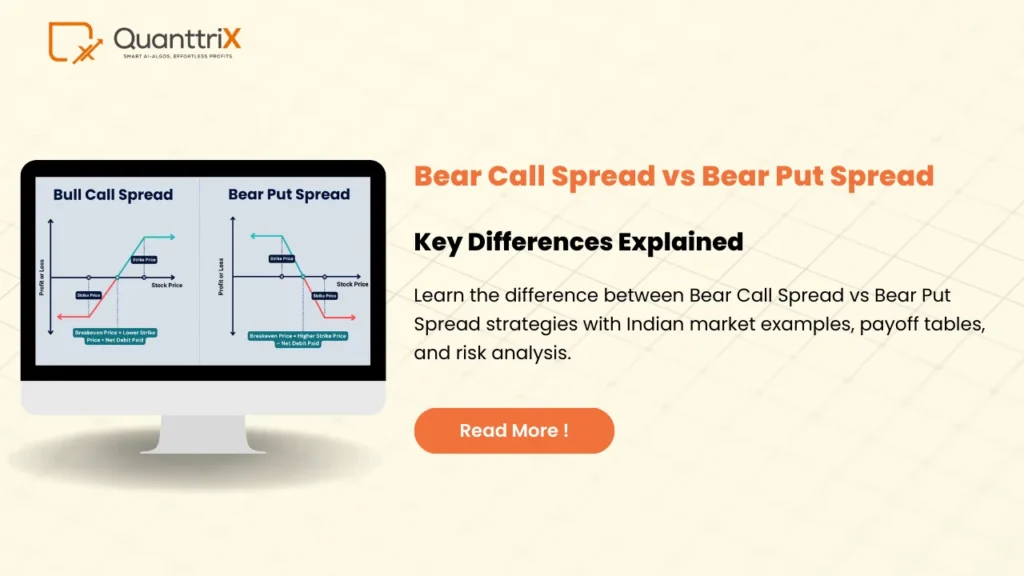
Bear Call Spread vs Bear Put Spread: 7 Differences Explained
Once the markets become unpredictable or slightly bearish, traders usually seek measures that help them in keeping the risk at minimal levels and at the same time accomplish steady returns. It is at this point that bearish option spreads are involved. Experienced traders not only use structured spreads to manage capital and deal with the downside rather than taking unlimited risk by selling naked options or buying costly puts.
The Bear Call Spread and the Bear Put Spread are some of the most utilized bearish strategies. Although both are designed to gain when the market goes down or the market goes into a range, their construction, cost, risk profile and optimal application are much different.
Bear Call Spread vs Bear Put Spread in this guide is disaggregated in a simple conversational style, with payoff table, Indian cases, and decision models, so that you can easily select the proper strategy to fit your trading style.
What Is a Bearish Options Strategy?
A bearish options strategy is designed to benefit when:
- The price falls
- Or stays below a certain level
- Or moves sideways with a bearish bias
Instead of betting on sharp crashes, most professional traders focus on high-probability bearish setups that offer controlled risk and defined rewards.
What is Bear Put Spread?
A Bear Put Spread is an options trading strategy in which a trader purchases a higher priced put option and also sells a lower priced put on the same stock and the same expiry date. It is applied when a trader anticipates the stock price to fall medium and the risk and cost is to be limited.
Bear Put Spread Strategy Meaning
A Bear Put Spread involves:
- Buying a Put option at a higher strike price
- Selling a Put option at a lower strike price
- Both options have the same expiry
This strategy benefits from a moderate fall in price.
When to Use Bear Put Spread Strategy?
- You expect the market or stock to decline
- You want limited risk
- You prefer lower cost than buying a naked put
Bear Put Spread Strategy – Structure Example (Index)
Example: NIFTY 50 (Hypothetical)
Action | Strike | Premium |
Buy Put | 22,000 | ₹180 |
Sell Put | 21,700 | ₹90 |
Net Debit (Cost) = ₹90
Lot Size (NIFTY) = 50
Bear Put Spread Payoff Table – NIFTY
NIFTY Expiry Level | Net P/L (₹) |
Above 22,000 | -4,500 |
21,900 | -2,000 |
21,800 | +500 |
21,700 | +4,500 |
Below 21,700 | +4,500 |
Maximum Loss: Limited to premium paid
Maximum Profit: Difference between strikes – premium
What Is Bear Call Spread?
A Bear Call Spread is an options strategy where a trader sells a call option at a lower strike price and buys another call at a higher strike price with the same expiry. Bear Call Spread Strategy is used when a trader expects the stock price to stay below or fall, earning limited profit with controlled risk.
Bear Call Spread Strategy Meaning
A Bear Call Spread is a credit strategy, where you:
- Sell a Call option at a lower strike
- Buy a Call option at a higher strike
- Same expiry for both options
This strategy profits when the market stays below a certain level.
When to Use Bear Call Spread Strategy
- You expect sideways to mildly bearish movement
- You want income generation
- You prefer higher probability trades
Bear Call Spread Strategy – Structure Example (Stock)
Example: Reliance Industries (Hypothetical)
Action | Strike | Premium |
Sell Call | ₹2,500 | ₹45 |
Buy Call | ₹2,560 | ₹18 |
Net Credit Received = ₹27
Lot Size = 250
Bear Call Spread Payoff Table – Reliance
Reliance Expiry Price | Net P/L (₹) |
Below ₹2,500 | +6,750 |
₹2,520 | +2,500 |
₹2,550 | -1,250 |
₹2,560 or above | -8,250 |
Maximum Profit: Net premium received
Maximum Loss: Difference between strikes – credit
Bear Call Spread vs Bear Put Spread: Key Differences
Factor | Bear Call Spread | Bear Put Spread |
Market View | Sideways to Bearish | Moderately Bearish |
Cost | Credit (receive premium) | Debit (pay premium) |
Risk | Limited | Limited |
Reward | Limited | Limited |
Probability | Higher | Lower |
Capital Blocked | Lower | Higher |
Best For | Income traders | Directional traders |
Strategy | Ideal Market | Capital | Risk–Reward |
Bear Call Spread | Range-bound below resistance | Low | High probability |
Bear Put Spread | Breakdown from support | Medium | Higher payoff |
Stock Example Comparison (Reliance)
Strategy | Best Scenario |
Bear Call Spread | Stock stuck below resistance |
Bear Put Spread | Weak earnings or breakdown |
Greeks Impact Explained (Simple Terms)
- Theta (Time Decay) – Favors Bear Call Spread
- Delta (Directional Move) – Favors Bear Put Spread
- Vega (Volatility) – Rising volatility helps Bear Put Spread. Falling volatility helps Bear Call Spread.
Common Mistakes Traders Make
- Using Bear Put Spread Strategy in low volatility
- Using Bear Call Spread Strategy during strong downtrends
- Ignoring support and resistance
- Holding spreads till expiry without exit rules
Which Strategy Should You Choose?
Choose Bear Call Spread if:
- Market is weak but not crashing
- You want consistent income
- You prefer high-probability setups
Choose Bear Put Spread if:
- You expect a clear breakdown
- You want directional profits
- You are comfortable paying premium
Conclusion
Bear Call Spread vs Bear Put Spread is a potent tool when applied in appropriate market settings. It is not a matter of making a choice between the two strategies, but the actual advantage lies in learning how markets work, how volatile the market is and the likelihood of a particular outcome. Learn the logic, train with paper trades and then invest the actual capital without any fears.
To keep the strategy consistent with the market conditions Bear Call Spreads in times of consolidation and Bear Put Spreads in times of proven downward trends. These spreads can be very helpful in terms of consistency in options trading when they are controlled through proper risk management, defined exits and disciplined execution.
FAQ'S
What is the main difference between Bear Call Spread vs Bear Put Spread?
Bear Call Spread is a credit strategy for sideways markets, while Bear Put Spread is a debit strategy for bearish moves.
Which strategy is safer for beginners?
Bear Call Spread Strategy is generally safer due to higher probability and lower capital requirement.
Can Bear Put Spread give unlimited profit?
No, profit is capped at the difference between strikes minus premium paid.
Is Bear Call Spread affected by time decay?
Yes, time decay works in favor of Bear Call Spread traders.
Can these strategies be used in Indian markets?
Yes, both are widely used in NIFTY, BANK NIFTY, and large-cap stocks.

