
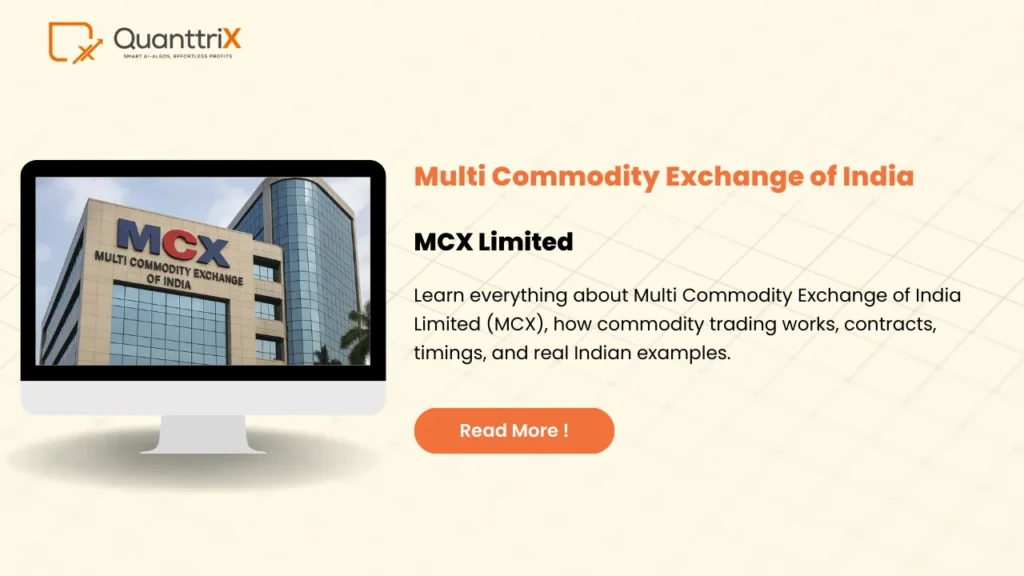
Multi Commodity Exchange of India - MCX Limited
When the majority of individuals consider the stock market, they think about the trading of stocks of such companies as Reliance or TCS on NSE or BSE. There is another strong arm of the Indian financial market, however, besides the equities that are commodities.
Active trade in gold, silver, crude oil, natural gas, copper, and farm products is conducted using a developed system of exchange. Multi Commodity Exchange of India Limited (MCX). is the heart of such an ecosystem.
Both traders wishing to diversify and every beginner who aims at knowing the commodity markets, it is important to know how MCX is operating. This step by step guide will discuss the definition of the multi commodity exchange, its functionality in India, contract specification, trading process as well as why it is significant in the overall Indian economy.
What is Multi Commodity Exchange?
Multi Commodity Exchange is a structured exchange in which commodity derivatives, e.g. futures and options, are bought and sold.
In India, commodity derivatives can be traded mostly through:
- Multi Commodity Exchange of India Limited (MCX)
- It has the highest number of future contracts traded in Asia as a commodity exchange.
Full Form
Multi Commodity Exchange of India Ltd- also referred to as MCX.
It allows price discovery and risk management on commodities within such sectors as:
- Bullion (Gold, Silver)
- Energy (Crude Oil, Natural Gas)
- Base Metals (Copper, Zinc, Aluminium)
- Agri Commodities (Mentha Oil, Cotton)
Introduction of Multi Commodity Exchange of India Limited.
Multi Commodity Exchange of India Limited (MCX) has been the largest commodity derivatives exchange in India and it offers an open and regulated market of trading futures and options contracts of commodities like bullion, energy, base metals and agricultural products.
MCX was formed in 2003 when it had its headquarters in Mumbai and it is regulated by SEBI and it is a large price discovery and risk management platform of the market players who are trading, hedging and the institutional investors. Having a powerful electronic trading system and countrywide networks MCX has already become one of the pillars of the Indian system of commodity trading.
- Established: 2003
- Headquarters: Mumbai
- Regulator: securities and exchange board of India (SEBI).
- Segments: Commodity Derivatives.
Multi Commodity Exchange of India Limited provides an electronic trading platform of commodity futures and contracts of commodity options. It operates using the same principle as NSE and BSE except that it trades in commodities and not equities.
Why Was Multi Commodity Exchange of India Introduced?
Before organized exchanges like MCX, commodity trading in India happened mostly through informal markets. Prices varied widely across regions.
MCX was introduced to:
- Bring transparency to commodity pricing
- Enable hedging for producers and consumers
- Standardize contracts
- Improve liquidity
- Reduce counterparty risk
For example:
- A jeweller in Mumbai can hedge gold price risk.
- An oil importer can hedge crude oil exposure.
- A copper manufacturer can lock future prices.
How Does Multi Commodity Exchange Work?
The multi commodity exchange of India operates through standardized derivative contracts.
Step 1: Contract Creation
Each commodity has specific contract specifications:
- Lot size
- Tick size
- Expiry date
- Delivery mechanism
Example:
Gold futures on MCX typically trade in:
- 1 kg contract
- Mini contracts (100 grams)
Step 2: Margin Requirement
Instead of paying full contract value, traders deposit an initial margin (usually 5–15%).
Example:
If gold value = ₹60 lakh
Margin required = approx. ₹3–6 lakh
This makes commodity trading leveraged.
Step 3: Daily Mark-to-Market (MTM)
Profits and losses are settled daily based on price movement.
Major Commodities Traded on MCX
1. Bullion
- Gold
- Silver
India is one of the largest consumers of gold globally. Hence gold futures are highly liquid.
2. Energy
- Crude Oil
- Natural Gas
Crude oil contracts are popular among intraday traders due to volatility.
3. Base Metals
- Copper
- Zinc
- Aluminium
- Lead
Copper is often called “Dr. Copper” because it reflects economic health.
4. Agri Commodities
- Cotton
- Mentha Oil
These contracts support farmers and exporters.
Example: How an Indian Trader Uses MCX
Suppose:
Rahul is a trader from Delhi who expects crude oil prices to rise.
- Current Crude Price: ₹6,000 per barrel
- He buys 1 lot
- Margin paid: ₹50,000 (approx.)
If price moves to ₹6,200:
Profit = ₹200 × lot size
This leveraged nature makes MCX attractive – but also risky.
Trading Timings of Multi Commodity Exchange of India Ltd
MCX operates longer hours compared to equity markets.
Typical timings:
- 9:00 AM to 11:30 PM (Non-Daylight Saving)
- Extended hours for energy contracts
This allows Indian traders to participate in global commodity movements.
Difference Between MCX and NSE
Feature | MCX | NSE |
Segment | Commodities | Equities & F&O |
Assets | Gold, Oil, Metals | Shares, Index |
Timing | Extended | 9:15 AM–3:30 PM |
Leverage | High | Moderate |
MCX is for commodity derivatives; NSE is primarily for stocks and index trading.
How Prices Are Determined on MCX?
Prices are influenced by:
- Global commodity exchanges (COMEX, NYMEX)
- Dollar-rupee exchange rate
- Demand-supply dynamics
- Inflation expectations
- Geopolitical events
Example:
If US crude inventory falls, crude prices globally rise – impacting MCX crude futures.
Role of MCX in Indian Economy
Multi Commodity Exchange of India Limited plays a critical role in:
- Price Discovery
- Risk Management
- Inflation Signaling
- Hedging for Businesses
Jewellers hedge gold exposure.
Airlines hedge fuel exposure.
Exporters hedge metal price fluctuations.
Who Should Trade on MCX?
- Hedgers (Businesses)
- Speculators (Traders)
- Arbitrageurs
- Portfolio Diversifiers
However, beginners must understand leverage risk.
Risks in Commodity Trading
- High Volatility
- Leverage Risk
- Global Event Risk
- Currency Fluctuation
For example:
Crude oil can move 3–5% in a single day. Proper risk management is essential.
How to Start Trading on Multi Commodity Exchange of India?
- Step 1: Open commodity trading account
- Step 2: Complete KYC
- Step 3: Activate MCX segment
- Step 4: Understand contract specs
- Step 5: Start with small lots
Most Indian brokers provide MCX access.
MCX Stock – Investment Perspective
Multi Commodity Exchange of India Ltd is also a listed company on NSE.
Investors track:
- Revenue growth
- Volume growth
- Regulatory developments
- Competition
MCX revenue depends heavily on commodity trading volumes.
Why does MCX matter?
- Price action in commodities
- Intermarket analysis
- Risk management
- Hedging strategies
Commodity markets often move differently from equity markets. Understanding MCX can give traders diversification and opportunity.
Conclusion
The Multi Commodity Exchange of India Limited has transformed the way commodities are traded in India. From gold and silver to crude oil and metals, MCX offers a transparent and regulated environment for price discovery and hedging. Its extended trading hours, leveraged contracts, and global linkage make it both an opportunity and a responsibility for traders.
However, commodity trading is not gambling – it requires structured learning, disciplined risk management, and a clear strategy. For Indian traders looking to expand beyond stocks and indices, understanding the multi commodity exchange of India can open a powerful new segment of the financial markets. With proper education and risk control, MCX can become a valuable addition to your trading portfolio.
FAQ'S
What is Multi Commodity Exchange of India Limited?
Multi Commodity Exchange of India Limited (MCX) is India’s leading commodity derivatives exchange regulated by SEBI.
What commodities are traded on MCX?
Gold, silver, crude oil, natural gas, copper, zinc, aluminium, cotton, and mentha oil are actively traded.
Is MCX regulated?
Yes, MCX is regulated by SEBI under the Securities Contracts Regulation Act.
Can beginners trade on MCX?
Yes, but beginners should start with proper education and risk management due to leverage.
What are MCX trading hours?
MCX generally operates from 9:00 AM to 11:30 PM for most contracts.

