
Iron Condor Strategy Meaning, 2 Types Explained for Traders
Options trading in India has evolved far beyond simple call and put buying. Being of high liquidity, with weekly expiry and rising retail participation, market participants are now looking at structured-probability based strategies as opposed to directional guesses. The iron condor option strategy is one of the most popular strategies of the type.
The iron condor plans are aimed at traders who suppose the market to be in a certain range. It is less directional, and more time depreciated, volatility controlled, and disciplined risk management. It is very applicable to Indian indices such as NIFTY, BANKNIFTY, and FINNIFTY where the sideways movement is a common occurrence throughout most of the week.
Here, you would understand what is iron condor strategy, how it is applied in the Indian market, the distinction between the short iron condor and long iron condor, and when it should and should not be applied.
What is Iron Condor Strategy?
Using a condor of iron is a strategy in the trading of options which is a neutral strategy that entails two calls and two puts in that order, and it is structured in such a manner that it limits the amount of profit and the amount of loss made.
In simple terms, an iron condor allows you to:
- Profit when the market stays within a range
- Define risk in advance
- Benefit from time decay (theta)
Because risk is capped, it is considered a safer alternative to naked option selling, especially in the Indian derivatives market.
What is Iron Condor Strategy?Why is it popular in India?
The Indian options market offers unique advantages:
- Weekly index expiries
- High liquidity in index options
- Predictable volatility cycles
- Broker margin benefits for hedged strategies
Due to these factors, the iron condor option strategy has become a favourite among:
- Positional option sellers
- Weekly income traders
- Risk-aware retail traders
In indices like NIFTY and BANKNIFTY, the market often spends time consolidating, which suits iron condor perfectly.
Basic Structure of Iron Condor Option Strategy
An iron condor is created using two spreads:
- One call spread
- One put spread
Components:
- Sell one out-of-the-money (OTM) call
- Buy one further OTM call (hedge)
- Sell one OTM put
- Buy one further OTM put (hedge)
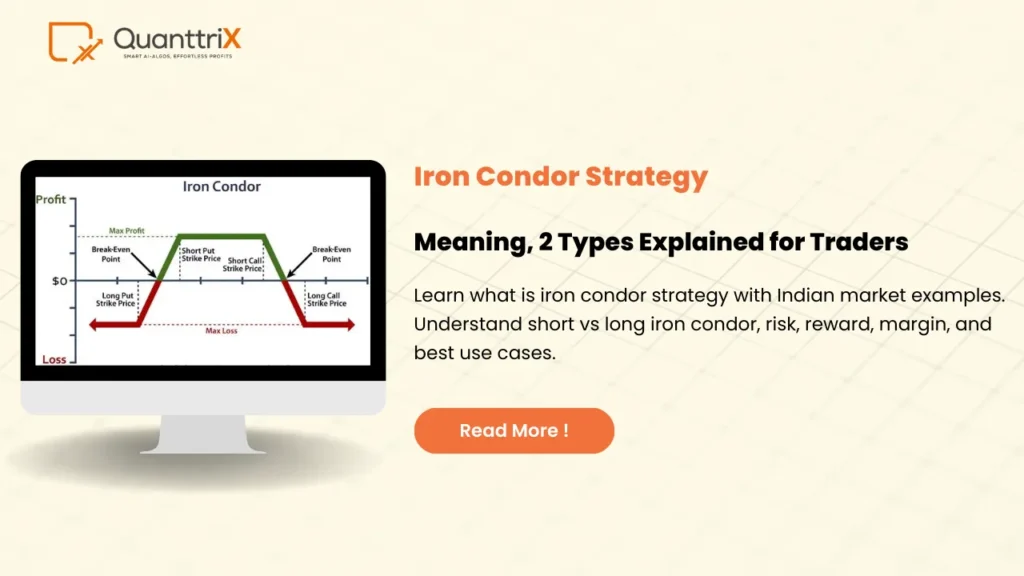
This structure creates a profit zone between the two sold strikes.
What is the Short Iron Condor Strategy?
The short condor strategy is the most commonly used version in the Indian market.
Market View
- Expect market to stay range-bound
- Expect low to moderate volatility
Objective
- Earn premium
- Benefit from time decay
Risk Profile
- Maximum profit is limited
- Maximum loss is limited
This strategy benefits when the underlying expires between the sold call and sold put strikes.
Short Condor Strategy - Indian Market Example
Assume NIFTY is trading at 22,000.
Trade Setup:
- Sell 22,300 CE
- Buy 22,500 CE
- Sell 21,700 PE
- Buy 21,500 PE
Outcome at Expiry:
- If NIFTY expires between 21,700 and 22,300 → maximum profit
- If NIFTY moves beyond the outer strikes → loss is capped
This wide range is why iron condors are often preferred over iron butterflies.
What is the Long Iron Condor Strategy?
The long iron condor is the reverse of the short condor.
Market View
- Expect high volatility
- Expect strong directional movement
Structure
- Buy the inner strikes
- Sell the outer strikes
Usage
This version is rarely used by retail traders in India because:
- Risk-reward is less favourable
- Requires accurate volatility timing
Most Indian traders focus on the short iron condor strategy.
Maximum Profit and Maximum Loss
Maximum Profit
- Net premium received
- Occurs when price stays within the range
Maximum Loss
- Difference between spread strikes minus premium
- Known before placing the trade
This predefined structure is critical for capital protection, especially for traders with limited funds.
Margin Requirement for Iron Condor in India
One major advantage of the iron condor option strategy is lower margin requirement.
Because:
- Both call and put sides are hedged
- Risk is defined
Indian brokers typically block:
- 25–40% less margin compared to naked option selling
This makes iron condor ideal for retail traders and small accounts.
Iron Condor vs Iron Butterfly
Many traders confuse iron condor with iron butterfly options strategy.
Key Difference:
Feature | Iron Condor | |
Sold strikes | Different | Same (ATM) |
Range | Wider | Narrow |
Reward | Moderate | Higher |
Risk | Lower | Slightly higher |
Iron condor is more forgiving, making it better for consistency.
Best Time to Use Iron Condor Strategy
The iron condor strategy works best when:
- Market is consolidating
- India VIX is falling
- No major events are scheduled
- Expiry is near
Avoid using iron condor during:
- Budget week
- RBI policy days
- Global uncertainty
Ideal Timeframe for Indian Traders
Most Indian traders deploy iron condor:
- 4–6 days before weekly expiry
- Or at the start of the week
As expiry approaches, theta decay accelerates, increasing profitability.
Greeks Impact in Iron Condor Strategy
Understanding Greeks improves execution.
Theta
- Positive
- Works in favour of seller
Vega
- Negative
- Falling volatility helps
Delta
- Close to neutral initially
This makes iron condor a volatility-selling strategy.
Risk Management Rules for Iron Condor
Even defined-risk strategies need discipline.
Best practices:
- Exit if spot breaches range
- Don’t wait till max loss
- Adjust strikes if needed
- Avoid over-leveraging
Professional traders treat iron condor as a process, not a gamble.
Common Mistakes Indian Traders Make
- Using too narrow range
- Trading during news events
- Holding till expiry blindly
- Ignoring volatility indicators
- Increasing lot size emotionally
Iron condor rewards patience and consistency, not excitement.
Who Should Use the Iron Condor Strategy?
Iron condor is suitable for:
- Intermediate traders
- Option sellers
- Positional traders
- Traders aiming for steady income
It is not ideal for beginners without options knowledge.
Is Iron Condor Safe for Beginners?
Beginners should first understand:
- Option basics
- Spreads
- Risk management
Once comfortable, iron condor is one of the safest option-selling strategies to start with.
Conclusion
The iron condor option strategy is an effective, risk-specific strategy that is geared towards the Indian derivatives market. It enables traders to trade with clarity and not feeling, volatility exposure and the ability to make profits off of sideways movement.
With the appropriate choice of strike, timing, and discipline, the short iron condor can achieve consistent performance in the long run. Nevertheless, it would not rely on the strategy itself but rather on the control of risks, patience, and being aware of the market setting.
The iron condor strategy is one of the essential steps particularly to traders who prefer to get out of random trades and into the professional mind of trading.
FAQ'S
What is iron condor strategy?
It is a neutral options strategy that profits when the market stays within a defined range.
Is iron condor strategy safe?
Yes, risk is limited and predefined, making it safer than naked option selling.
Which market is best for iron condor in India?
NIFTY and BANKNIFTY due to liquidity and weekly expiries.
What is the difference between long and short iron condors?
Short condors benefit from low volatility, while long iron condors benefit from high volatility.
Can beginners use the iron condor strategy?
It is best suited for intermediate traders with basic options knowledge.

