
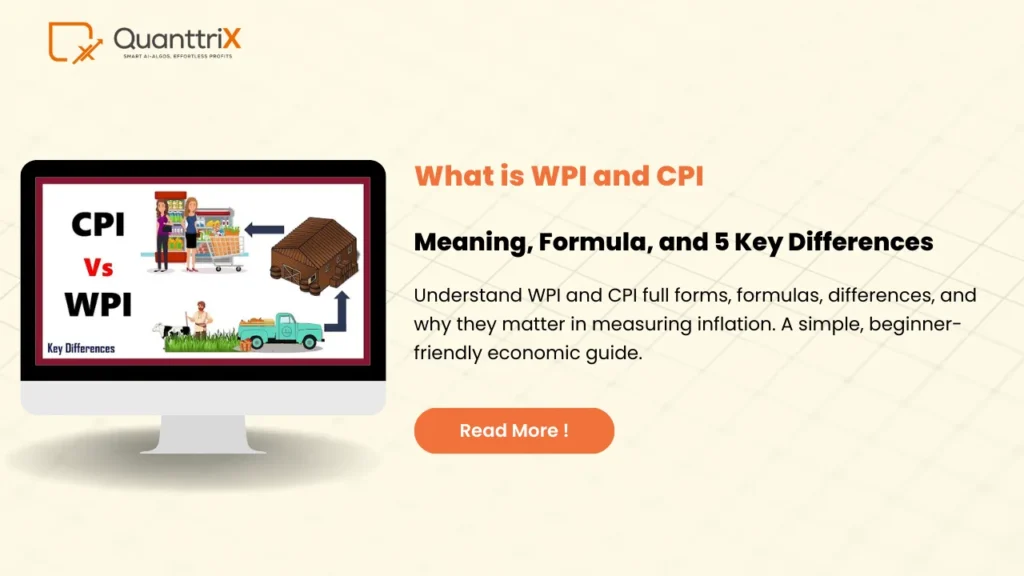
What is WPI and CPI: Meaning, Formula, and 5 Key Differences
Any time one hears about inflation, he or she hears about WPI and CPI, but only a few are truly aware of what these indexes measure. Inflation is not a farfetched phenomenon that only concerns economists. It influences the cost of a vegetable, the price of your travel and even the interest rate you pay on a house loan. There are two key inflation indicators in India and they are WPI and CPI.
WPI is used to monitor the wholesale prices, whereas CPI is used to monitor the consumer-retail price. This guide defines the CPI formula, the difference between CPI and WPI, CPI full form, WPI full form, applications, and the reason why both measures affect economic policy. We should take this one step at a time and make it very clear as a teacher would explain it in a classroom setting in a discussion.
CPI Full Form and Meaning
The complete acronym of CPI is Consumer Price Index. In its most simplistic form, CPI is an index that follows the price of a basket of goods and services to the average household. Consider a simple list of things that the majority of families purchase on a regular basis: vegetables, grains, cooking oil, transport, rent, electricity, school fees, medicines and so on. In case the price of this basket increases, CPI increases. CPI decreases in case the basket becomes less expensive.
CPI is a measure of living cost essentially. It takes the feeling of you and me, right in our pockets. That is why it matters so much. When they talk of inflation reaching a given point, in most instances, the estimate that is being quoted is a CPI inflation.
Since the CPI is used to indicate the actual price squeeze experienced by the households, the Reserve Bank of India relies on it as the primary reference point in determining the interest rates. Alterations in CPI can impact the repo rate, EMIs and yields of investment and demand in the economy.
CPI Formula Explained Simply
The CPI formula is usually presented in technical form, but the underlying idea is easy to grasp. You compare how much a typical consumption basket costs today versus how much the same basket cost in a chosen base year.
Here is the CPI formula written plainly:
CPI = (Current Cost of Basket ÷ Base Year Cost of Basket) × 100
If the basket of goods cost ₹1,000 in the base year and ₹1,080 now, CPI becomes 108. This suggests that consumer-level prices have risen by 8 percent.
Notice how this method focuses entirely on the consumer’s perspective. It does not care what wholesalers or manufacturers pay for raw materials. CPI is strictly about what retail buyers pay.
WPI Full Form and Meaning
WPI full form means Wholesale Price Index. It is an indicator of the change of prices at wholesale rather than at the retail shop. That is, it monitors the expenses incurred by the businesses in purchasing the raw materials, intermediate goods, and bulk commodities.
If a steel producer, textile factory, or food-processing company faces higher input costs, that shows up in WPI. Because WPI deals with the early stage of the production pipeline, it moves ahead of CPI in many cases. If wholesale prices rise sharply, there is a good chance consumer prices will rise later—unless producers absorb the cost.
WPI covers categories such as minerals, food grains, chemicals, cement, metals, crude oil, and industrial products. It excludes most services. That is one of the major differences between WPI and CPI: CPI includes both goods and services; WPI includes only goods.
WPI Formula Explained
WPI formula uses a weighted index method. In plain language, certain items matter more than others, so they are assigned higher weights. Items that are important for industrial production get more weight than minor commodities.
The simplified WPI formula is:
WPI = (Weighted Price of Basket in Current Year ÷ Weighted Price in Base Year) × 100
If the weighted wholesale basket rises from 120 to 132, WPI becomes 110. That means wholesale prices have increased by 10 percent.
Despite the similarity in the appearance of the formula, the different composition of the basket and the point of capturing the prices make WPI entirely a different indicator.
Why Do We Need Two Inflation Measures?
The most frequent question, which is raised by the students, is why the country requires both the WPI and the CPI. Wouldn’t one index be enough? The response to this question is no, as each index tells not a similar story.
WPI measures the pressure in terms of prices of producers and wholesalers. CPI measures the pressure experienced by the consumers. In other cases, wholesale prices can pop up because of the world market shock of commodities, but the retailers will not immediately transfer the shock to the retail price. During such times, WPI increases at a higher rate than CPI. At other moments, the retail inflation is increasing but the wholesale prices are constant, maybe because of shortages in season or increased costs of distribution. Then CPI will shoot up but WPI will not increase.
The indexes are complementary to one another. The combination of them gives a more complete picture of the inflation dynamics.
Difference Between CPI and WPI
Basis | WPI (Wholesale Price Index) | CPI (Consumer Price Index) |
Meaning | Measures price changes at the wholesale level, i.e., between businesses. | Measures price changes at the retail level, i.e., for consumers. |
Coverage | Includes goods only (no services). | Includes both goods and services consumed by households. |
Base of Measurement | Based on prices of bulk transactions or wholesale markets. | Based on prices of goods and services purchased by consumers. |
Purpose | Used to track inflation at the producer or wholesale level. | Used to track cost of living and consumer inflation. |
Published By | Published by the Office of Economic Adviser, Ministry of Commerce and Industry. | Published by the National Statistical Office (NSO), Ministry of Statistics and Programme Implementation. |
How the difference between CPI and WPI Affect the Economy?
Inflation is not just a number in a report. It has ripple effects that shape economic decisions.
In the case where CPI increases beyond the comfort margin, the central bank can restrict the monetary policy by increasing interest rates. This has an impact on home loans, business loans, investment sentiment, and the consumption patterns. The constant increase in CPI implies that there is financial pressure among households.
However, WPI tells otherwise. When WPI rises at a high rate, it is an indication that the cost of inputs in the industries is rising. When the manufacturers are unable to transfer these increased costs to the consumers, they become smaller in margin. Cement, steel, chemicals, textile, and FMCG are particularly sensitive to the trends in WPI.
In the case of traders, a high level of WPI may reflect that the commodity-driven sectors are feeling the strain. To the long term investors, a sustained inflation of CPI can be an indicator of reduced monetary policy in the future.
WPI/CPI Movement using Real-life examples?
Take a situation when the international price of crude oil is increasing drastically. The oil refineries begin paying higher prices on crude thus WPI increases initially. At a later stage when the petrol and diesel prices are adjusted at the pumps, CPI increases since transport expenses influence nearly everything.
Or take a seasonal food example. During a bad monsoon season, vegetable prices spike. Since households feel the impact immediately, CPI rises quickly. But if wholesalers already had enough stock or if certain vegetables are excluded from the wholesale basket, WPI may not move as sharply.
These simple examples show how the two indicators do not always behave in sync.
Why CPI Became India’s Main Inflation Gauge?
For many years, India relied heavily on WPI as the primary inflation metric. But as the economy expanded and services became a large part of household spending, WPI no longer captured inflation accurately.
CPI covers services like healthcare, education, and transport, which form a significant share of modern expenses. That is why RBI shifted to consumer price-based inflation targeting. CPI tells policymakers how inflation affects real living costs, wages, demand, and household budgets.
WPI still remains useful, but it is no longer the main inflation number India watches.
Practical Uses: Where WPI & CPI Matter Most
CPI is used for:
- Adjusting dearness allowance.
- Pension revisions.
- Monetary policy decisions.
- Understanding household-level inflation.
- Comparing cost-of-living changes over time.
WPI is used for:
- Analysing industrial input costs.
- Projecting margins for manufacturing companies.
- Commodity price tracking.
- Supply chain cost studies.
- Contract escalation clauses in many industries.
Both indexes feed into economic analysis, but for different reasons.
Why Traders Should Understand WPI & CPI?
For someone trading in equity or currency markets, inflation numbers often act as early signals. Rising CPI may push the central bank toward tighter policy, affecting interest-rate-sensitive stocks. Rising WPI may indicate that manufacturing sectors could face margin pressure.
Understanding WPI & CPI helps traders anticipate policy announcements, sector movements, and even bond yields. It also gives insight into consumer behaviour and industrial cost cycles.
Conclusion
WPI and CPI might seem to be technical economic terms yet they tell essential details of price changes within the economy. CPI is an indicator of the rising cost of living, whereas WPI is an indicator of how industries are managing the increase in the cost of inputs. The CPI-WPI difference has various roles and they provide a better understanding of inflation.
Be it as a student about to take an exams, a trader working on the macro indicators, or just a person watching why the prices seem higher each year, it is really handy to know the distinction between WPI and CPI. After understanding the operation of these indexes, it is much more meaningful to read the news of inflation.
FAQ'S
What is the CPI full form?
Consumer Price Index.
What is the WPI full form?
Wholesale Price Index.
What is the main difference between CPI and WPI?
CPI tracks retail prices; WPI tracks wholesale prices.
Why is CPI in use by RBI in their inflation targeting?
Since CPI represents actual household inflation in a better way.
Does WPI include services?
No, WPI will primarily discuss goods whereas CPI will involve both services and goods.
What is the WPI formula?
WPI = (Current Price / Base Year Price) × 100
What is the CPI formula?
CPI = (Cost of Basket in Current Year / Cost of Basket in Base Year) × 100