
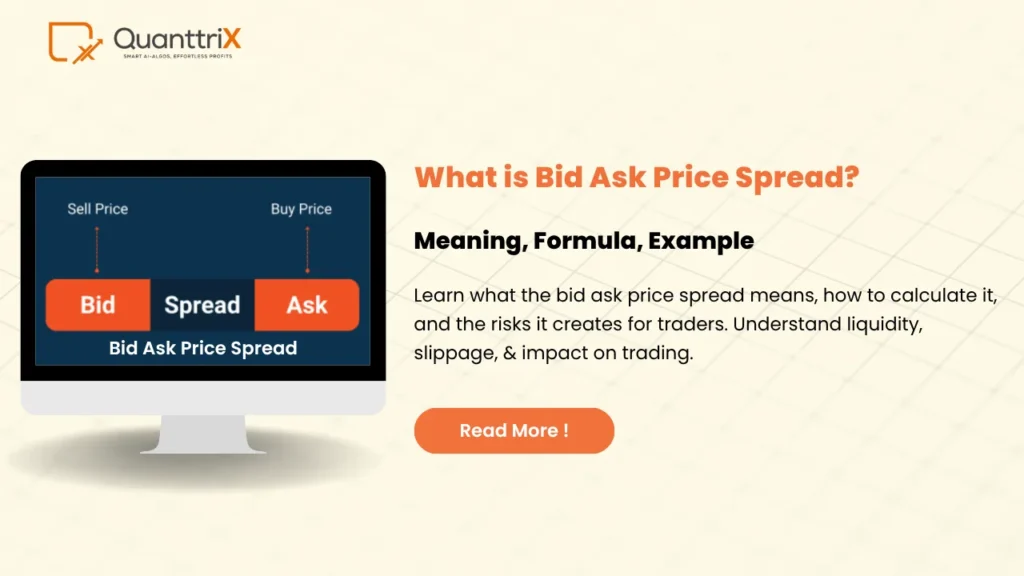
What is Bid Ask Price Spread? Meaning, Formula, Example
Bid and ask are the prices that a buyer and a seller are ready to pay and offer respectively. It gives the reason why the price being displayed in a chart is normally not the same as the price a trader actually gets. The bid-ask spread is a measure of the market liquidity, the levels of trading, and the way the two parties negotiate on the spot.
Most traders focus on patterns and signals, but the bid ask price spread is one of those details that quietly influences every execution. To make sense of it, here’s a straightforward explanation written in a way traders usually discuss these things among themselves – The spread affects every entry, It reflects how active the market is, Understanding it helps avoid sloppy trades.
What the Bid and Ask Really Represent?
Every stock has two active prices at any moment: the bid and the ask. The highest someone is willing to pay becomes the bid. The lowest someone is willing to sell becomes the ask. Traders who have spent time looking at the order book know how the spread keeps moving as orders come and go.
The bid ask spread is simply the gap between those two numbers. Understanding what the bid ask spread means will help to identify whether the stock is stable, active, or behaving strangely.
- Bid shows buyers’ intentions.
- Ask shows sellers’ expectations.
- The spread shows the tension between both sides.
Why the Bid and Ask Spread Exists?
A common question beginners ask is why the market doesn’t just show one price. This is because of the simple reason that buyers and sellers rarely desire the same quantity. When a buyer is willing to pay ₹200 and a seller demands ₹201; the market exhibits the same. That spread is the bid and ask and it is always changing in relation to urgency and participation.
- Buyers push from below.
- Sellers push from above
- Spread is the middle ground where they try to meet.
That’s all there is to it. Nothing mysterious – just negotiation happening live.
Understanding the Bid Ask Spread Formula
Many traders recognise the concept but not the exact bid ask spread formula. It’s much simpler than it sounds.
- Spread = Ask Price – Bid Price
- Spread % = (Ask – Bid) ÷ Ask × 100
Even though the formula is simple, the implications can be big. A spread of ₹2 in a ₹40 stock is huge. A ₹2 spread in a ₹1,500 stock barely affects anything. This is where knowing the bid ask price spread helps decide whether a counter is tradable at all.
Why Should Traders Pay Attention to the Spread?
The spread is the first cost of entering a trade. When you buy at the ask and immediately sell at the bid, the difference becomes an instant loss. Traders who ignore the bid ask spread often wonder why they start a trade in the red even when the chart looks fine. Understanding what the bid ask spread means helps traders filter out stocks that look good on charts but behave poorly during execution.
- Wide spreads mean higher slippage
- Tight spreads mean smoother trades
- Spread behaviour hints at crowd sentiment
What Controls the Width of the Spread?
Spreads widen or narrow based on a few very clear factors that traders eventually learn to read instinctively.
- Liquidity: More volume = tight spread; low volume = wide spread
- Volatility: High volatility pushes spreads apart
- Time of day: Spreads behave differently at open and close
- News flow: Announcements widen spreads instantly
- Market depth: More orders = better spread stability
These elements explain why the bid ask price spread jumps suddenly during earnings announcements or economic events.
Illustrating the Spread With Simple Examples
Examples make this clearer. Suppose a stock shows:
- Bid: ₹320
- Ask: ₹321
Spread is ₹1 – this is normal for an active stock. Now imagine:
- Bid: ₹320
- Ask: ₹327
Spread is ₹7 – this signals danger. A trader who knows what the bid ask spread means would avoid the second stock unless taking a long-term view.
- Tight spread = active and liquid
- Medium spread = acceptable for midcaps
- Wide spread = potential trouble for intraday trades
Bid Ask Spread in Indices and Derivatives
When it comes to index futures or options, traders quickly notice that spreads don’t behave the same way as they do in individual stocks. The bid and ask spread in major indices like Nifty usually stays very tight because participation is consistently high and there’s always someone on the other side of the trade. But when the market enters a news-heavy phase-big announcements, data releases, or sudden global cues-even Nifty contracts see their spreads widen a bit as uncertainty kicks in.
- High index volume narrows spreads
- Low participation widens spreads
- Spread behaviour often reveals turning points
Many traders rely on spread movement as a subtle signal rather than a loud indicator.
How Spread Influences Order Execution?
Every order you place interacts with the spread. Market orders cross the spread immediately, while limit orders wait for a better match. Understanding the bid ask spread formula helps you calculate how much extra you’re paying simply because of execution.
- Market buy = you pay the ask
- Market sell = you accept the bid
- Limit orders reduce spread losses
Traders who study spreads save a surprising amount of money over time.
Narrow Spread vs Wide Spread Behavior
Most traders, even without formally studying it, start recognizing spread behavior just by watching the tape long enough. A narrow spread usually tells you the market is healthy-liquidity is strong, orders are flowing smoothly, and you can get in or out without much slippage. It’s the kind of environment where trades execute cleanly.
A wide spread, on the other hand, signals low participation or hesitation. Fewer buyers and sellers are active, and the sentiment is often uncertain. You end up paying more to enter or exit because the quotes are sitting far apart.
When the spread suddenly widens-especially in instruments that normally trade tight-it’s often a quiet warning. It usually means volatility is picking up, news is hitting the wires, or traders are stepping back. By paying attention to these shifts, traders can avoid illiquid entries and pick spots where execution is safer and more predictable.
Why Intraday Traders Must Understand the Spread?
Intraday traders operate on thin margins and quick moves. The bid ask price spread becomes crucial in fast trades because even a small widening can ruin an otherwise good entry.
- Scalpers depend on tight spreads
- Wide spreads reduce profit potential
- Spread spikes often indicate large orders entering
This explains why intraday traders often avoid stocks where spreads fluctuate excessively.
Frequent Errors Traders Make With Bid Ask Spread
New traders often fall into predictable mistakes simply because they ignore the spread. They look only at the chart price and forget the actual transaction price.
- Buying illiquid stocks with wide spreads
- Using only market orders
- Trading immediately after huge news
- Ignoring depth and volume data
These habits lead to unnecessary losses that could be avoided by simply watching the bid ask spread.
Steps to Reduce Spread-Related Losses
The good news is that spread-related mistakes are among the easiest to fix.
- Use limit orders whenever possible
- Stick to liquid stocks
- Avoid major announcements
- Trade mid-session for stability
- Check depth before clicking buy or sell
These simple steps keep execution controlled and predictable.
Conclusion
The bid ask spread is a simple yet powerful concept that shapes the real experience of trading. Once traders understand what the bid ask spread means, they avoid counters that look attractive in theory but behave poorly in execution. Observing the bid ask price spread gives a clearer picture of how active and confident the market is at any moment.
Using the bid ask spread formula helps traders calculate hidden costs and make smarter decisions. In the long run, traders who respect the spread end up with cleaner entries, smoother trades, and far fewer surprises – making it one of the quiet but essential tools in market understanding.
FAQ'S
What does bid ask spread mean?
It is the difference between the buyer’s price (bid) and the seller’s price (ask).
What is the bid ask spread formula?
Spread = Ask – Bid; percentage spread = (Ask – Bid) ÷ Ask.
Why is the bid ask price spread important?
It influences the real cost of buying and selling.
Can beginners ignore spreads?
No, ignoring spreads leads to poor execution.
Do long-term investors care about spreads?
Less than day traders, but still relevant.
Do spreads change all day?
Yes, they adjust constantly with order flow.

