
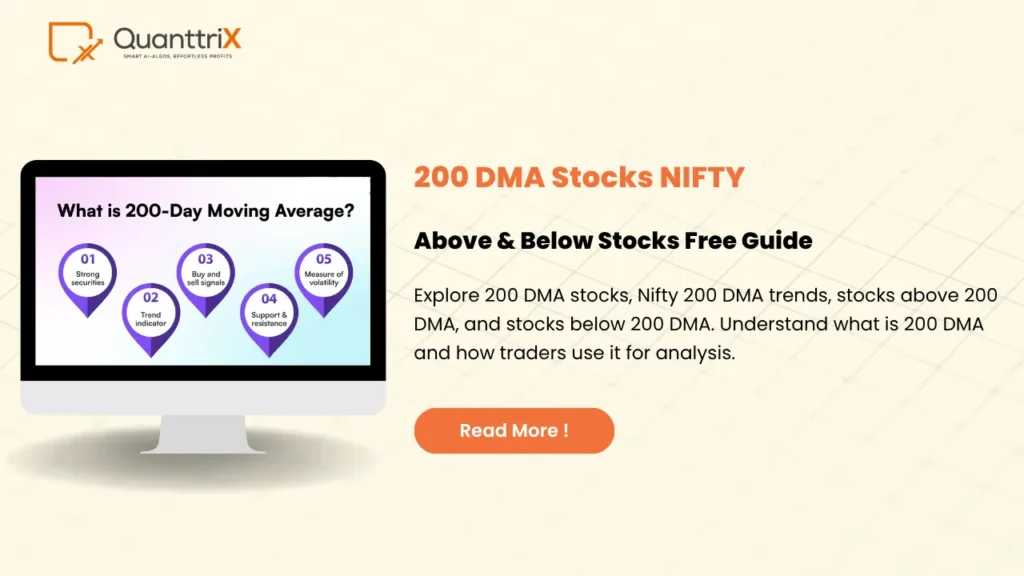
Best 200 DMA Stocks Nifty: Above & Below Stocks Guide
If you have ever wondered why analysts repeatedly talk about 200 DMA stocks, or why people react so strongly when the broader markets slip below the Nifty 200 DMA, the answer lies in the way long-term averages capture collective behavior. This blog aims to explain DMA in a practical, real-world style-more like a conversation traders would have over a cup of coffee rather than a technical manual.
We’ll also look at why lists such as stocks below 200 DMA and stocks above 200 DMA matter so much, especially to disciplined traders who value structure over instinct. Ask any trader who has been in the markets long enough, and they will tell you that no matter how many indicators you study, the market eventually teaches you to respect trends.
And one tool that quietly sits at the heart of most trend-based systems is the daily moving average, more popularly known as DMA. It doesn’t look fancy, and it doesn’t promise magical calls, and yet, for decades, traders around the world have used it to understand where money is flowing and where pressure is building.
What Is 200 DMA Stocks and Why Do Traders Care About It?
If you ask ten different traders, What is 200 DMA?, you might get ten variations of the same idea. Some will tell you it’s a long-term trendline. Others say it represents institutional behaviour. A few old-school traders call it the “line of truth,” because if a stock stays above it long enough, the trend often becomes obvious.
DMA, at its core, is the average closing price of a stock or index over a chosen number of days. You could calculate a 20-day DMA, a 50-day DMA, or even a 500-day DMA if you wanted, though most traders stick to the common ones. Among them, the 200 DMA holds a special place because it covers roughly one trading year, smoothing out noise and allowing you to see the underlying direction.
When someone discusses stocks under 200 DMA, they are referring to stocks that sit either comfortably above the average or are struggling below it. Both categories reveal something about strength, sentiment, and potential opportunity.
How DMA Is Calculated?
The formula is straightforward:
DMA = (Total of closing prices over X days) ÷ X
A 200 DMA averages the last 200 closing prices. A 50 DMA does the same for 50 days. That’s all there is to math. What matters is how these lines behave relative to price.
Why the 200 DMA Became the Most Influential Trend Indicator?
Traders could use any number of days, but the 200 DMA gained prominence because it offers enough data to smooth out almost everything – sudden rallies, sharp corrections, one-off events. If a stock trades above its 200 DMA for weeks or months, it often means the broader market participants are comfortable holding it.
The 200 DMA doesn’t predict the future. It simply reveals whether the long-term direction is healthy. For professional traders, that single insight is worth a lot.
Understanding 20, 50, 100, and 200 DMA Stocks
Different DMAs serve different purposes:
- 20 DMA – short-term momentum; good for traders who follow quick swings.
- 50 DMA – identifies intermediate trends; widely used to confirm continuation patterns.
- 100 DMA – balances short-term noise and long-term trajectory.
- 200 DMA – the line that most long-term investors and institutions watch.
Many traders don’t just rely on one DMA. They combine them, watching for crossovers or compression zones, especially when stocks transition from sideways movement into a breakout.
DMA | Purpose | Interpretation |
20 DMA | Short-term | Momentum and swings |
50 DMA | Mid-term | Trend confirmation |
100 DMA | Medium-term | Sustainability filter |
200 DMA | Long-term | Structural trend direction |
What are Stocks Above 200 DMA & Stocks Below 200 DMA?
These lists tell you much more than you think. A strong market typically has a larger number of stocks higher than 200 DMA, which suggests broad participation. When the count shrinks and more names fall into the stocks under 200 DMA bucket, momentum begins to weaken, often ahead of major corrections.
This concept applies at the index level too. The Nifty 200 DMA level is watched closely. Many institutional traders consider Nifty’s position relative to the 200 DMA as the dividing line between bullish and bearish territory.
How Traders Use DMA in Real-World Trading
Here are ways experienced traders use moving averages in day-to-day decisions:
Identifying Trend Direction
- Price above the 200 DMA = long-term strength.
- Price below the 200 DMA = long-term weakness.
Reclaim and Retest Entries
A stock that was below its 200 DMA for a long time but then climbs back above it often signals accumulation.
Golden Cross and Death Cross
These happen when:
- Golden Cross: 50 DMA rises above 200 DMA.
- Death Cross: 50 DMA slips below 200 DMA.
Traders treat these signals seriously because they reflect a shift in underlying behaviour.
Support and Resistance
The 200 DMA acts like a dynamic support or ceiling. Price often reacts strongly around this line.
A Realistic Example: How DMA Changes Interpretation
Imagine two traders watching the same stock. One sees momentum, the other sees weakness. But when both plot the 200 DMA, the picture becomes objective.
If the stock is part of the 200 DMA stock list (above the average), the long-term story is bullish. If it enters the stocks below 200 DMA category and stays there, the weakness is real, not imagined.
This simplicity is why DMA remains relevant even in a world full of complex indicators.
Common Mistakes Traders Make With DMA
Many traders misinterpret DMA because they assume it works like a shortcut to predicting the market. In reality, DMA is just a reference tool.
Treating DMA as a magic number
- Traders often believe the DMA will automatically signal a reversal or continuation. But DMA is based on past price data, not future movement.
- It helps you understand trend strength, not predict guaranteed outcomes.
Entering trades when price is far from DMA
- If the price has moved far above or below the DMA, the trade usually carries poor risk-reward.
- Such entries often happen when the move is already extended, making corrections more likely.
Ignoring volume
- DMA signals are incomplete without checking volume.
- A bounce or breakout near DMA is more reliable only when supported by strong volume.
- Without volume, the move may fail quickly.
Assuming all tests of 200 DMA will hold
- The 200 DMA is widely watched, but it does not act as support or resistance every time.
- Sometimes it holds firmly; other times, the price slices through it without hesitation.
- Treat it as a guide, not a guarantee.
Conclusion
In a market full of complex indicators and aggressive predictions, DMA stands out because of its simplicity. Whether you’re filtering 200 DMA stocks, evaluating Nifty 200 DMA, or scanning for stocks above 200 DMA or stocks below 200 DMA, DMA helps keep your trading grounded in trend logic rather than emotion.
Often, the question traders ask – what is 200 DMA, and why does it matter so much? – becomes clear once they plot it on their charts and see the consistency it brings. DMA won’t predict the future, but it gives your analysis structure and clarity – two things every long-term trader needs.
FAQ'S
Why do traders follow 200 DMA stocks?
Stocks above 200 DMA tend to show long-term strength, while those below indicate weakness.
Does Nifty 200 DMA matter for overall market direction?
Yes. When Nifty stays above the 200 DMA, sentiment is generally bullish. Falling below it weakens the market.
Are stocks below 200 DMA bad to buy?
Not always. Some become reversal opportunities when they reclaim the 200 DMA.
What is DMA and do institutions follow the 200 DMA?
It tends to filter noise and highlight the broader trend.
Can DMA be customized?
Yes. Traders can choose 20, 50, 100, or any period depending on their approach.
Should beginners use DMA?
Yes, DMA is one of the easiest trend tools for new traders.